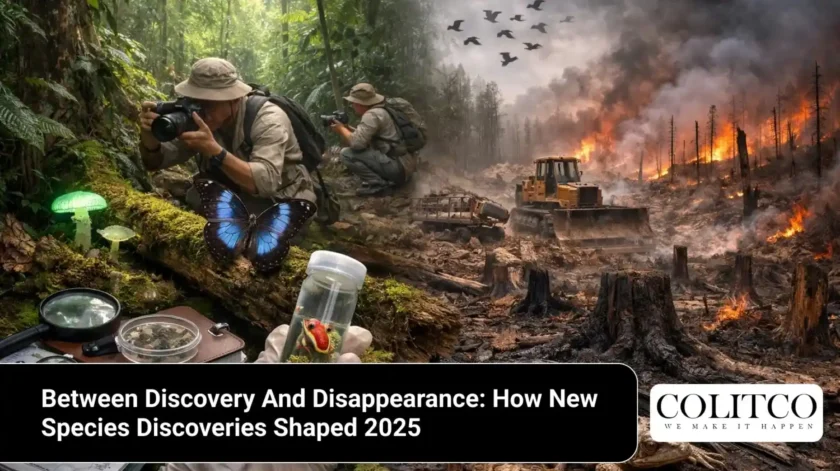
The year 2025 brought a clear message that the equilibrium of nature is still very much delicate. The scientific glass was half full thanks to the new species found, while the confirmed extinction kept the glass half empty. The extinction of wildlife in 2025 and later discoveries together told a story of how the environmental changes in that year moulded the ecosystems of the world.

Nature’s fragile balance exposed by 2025 discoveries and extinctions. [Source: Mongabay]
What Do New Species Discoveries Reveal About 2025?
The findings of 2025 concerning species showed that the biodiversity that is yet to be discovered is quite significant. After a long process of validation, scientists officially named hundreds of organisms.
Most of these were from isolated jungles, very deep waters, or old museum collections, and some of them were even wrongly classified for years. These discoveries proved that the number of those who have been scientifically registered as Earth’s species is very small compared to what actually exists.
A few of the new species dubbed were already very rare at the time of the discovery due to the environmental changes that were going on, and had been great for the whole year 2025. The results not only proved that the knowledge about biodiversity was still growing, but also that the knowledge about the ecological limits was getting narrower.
Which Species Were Officially Declared Lost In 2025?
The year 2025 brought about the extinction of wildlife species, as some of them on the IUCN Red List can finally be classified as extinct. The slippery curlew was last spotted in the 80s; since then, no sighting has been verified.
The extirpation of the Christmas Island shrew disease that rats carried also led to the extinction of the shrew. The Australian bandicoots were declared extinct a long time after the loss of their habitat and the killing of the predators that were interfering with them.
There are only plant species left in the herbarium samples. The cone snail was lost when the coastal development activity changed its shoreline. This was a gradual loss rather than a sudden catastrophe; it was a process of gradation rather than one-off extinction.
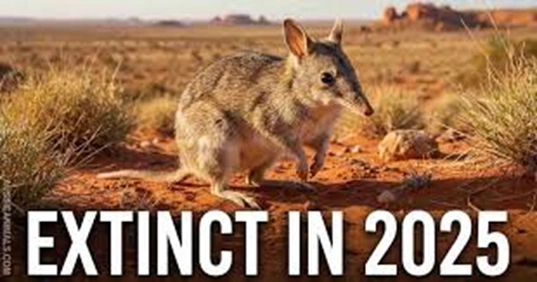
Australian bandicoots were declared extinct long after habitat loss. [Source: Aussie Animal]
Why Do Extinctions Often Go Unnoticed For Decades?
The process of extinction seldom happens singly. A lot of the animals and plants are still there, but they are the ones that are not noticed until the last piece of evidence is gone.
The process of conservation financing often creates a gap between the initial fear and the eventual giving in. Uncertain situations stretch out action to be taken, while the population declines without being noticed.
The Extinctions of 2025 recognised that the locked-in losses due to the late recognition could not be reversed anymore. The lack of emotions in the scientific listings highlighted the finality of these decisions.
New Species Discoveries Expose A Narrowing Window For Action
The discoveries of new species, on the other hand, without highlighting their urgency, did less to celebrate the situation. New mammals, fish, insects, plants, and marine species were discovered in almost every continent.
Among the examples were the marsupials of the Andean cloud forest and the deep-sea manta rays. The Ocean Census projects alone accounted for over 850 marine species.
Many of these lived in the endangered ecosystems that were already undergoing agricultural expansion or suffering from climate stress. Environmental changes in 2025 meant many species had reached extinction risk before the official recognition process even started.

Ocean Census revealed over 850 new marine species. [Source: CNN]
Conservation Efforts Showed Progress In Select Regions
Still, the conservation efforts in the targeted areas yielded better results even after the losses. Plans for the Great Koala National Park in Australia, aiming to cover 475,000 hectares, were approved.
The rainforest and Indigenous territories’ protected areas were expanded by the South American governments. Colombia banned the opening of new extractive projects in the Amazon region.
International treaties regarding the protection of high seas and fisheries subsidies reached important ratification milestones. All these actions showed that governance-based conservation could still change the outcomes.
What Lessons Did 2025 Leave For Global Conservation?
The combined record of 2025 delivered complex lessons. New species discoveries proved biodiversity remains richer than documented. Wildlife extinctions 2025 showed that time lost cannot be reclaimed.
Environmental changes 2025 emphasised that delay carries a measurable cost. Conservation success depended on enforcement, funding, and political continuity. The year confirmed that outcomes remain shaped by policy decisions rather than inevitability.
Also Read: 2026 Full Moons: Blood Moon, Blue Moon & Stunning Night Sky Events You Can’t Miss
FAQs
Q1: What are new species discoveries?
A1: New species discoveries occur when organisms are formally identified and described by scientists for the first time.
Q2: Why are wildlife extinctions often confirmed late?
A2: Many species decline unnoticed due to limited monitoring, funding gaps, and inaccessible habitats.
Q3: How did environmental changes affect biodiversity in 2025?
A3: Environmental changes 2025 accelerated habitat loss, climate stress, and ecosystem fragmentation globally.
Q4: Can conservation still reverse biodiversity loss?
A4: Targeted protection, governance reform, and sustained funding can still prevent future extinctions.