
Block Inc (NYSE: XYZ) shares shot up more than 24% in after-hours trading on Thursday, 26th February 2026, after CEO Jack Dorsey announced the company would axe more than 4,000 employees, reducing its global headcount from over 10,000 to just under 6,000.
The move is one of the most sweeping single-round layoffs in recent fintech history, and Dorsey framed it not as a crisis response, but as the inevitable future of every major corporation.
“I think most companies are late,” Dorsey wrote in a post on X. “Within the next year, I believe the majority of companies will reach the same conclusion and make similar structural changes. I’d rather get there honestly and on our own terms than be forced into it reactively.”
we’re making @blocks smaller today. here’s my note to the company.
####
today we’re making one of the hardest decisions in the history of our company: we’re reducing our organization by nearly half, from over 10,000 people to just under 6,000. that means over 4,000 of you are…
— jack (@jack) February 26, 2026
What Triggered the Mass Layoff Decision?
Dorsey’s explanation came down to two words: intelligence tools.
In his social media post, Dorsey indicated the company was cutting workers in favour of AI expansion, writing that intelligence tools paired with smaller, flatter teams are enabling a fundamentally new way to build and run a company.
Block, which operates Square, Cash App, Afterpay, and Tidal, had been quietly building its own in-house AI tool called Goose while exploring how automation could replace manual workflows across departments.
CFO Amrita Ahuja described the move as a strategic reset, writing that the company is choosing to shift how it operates at a time when its business is accelerating, and it sees an opportunity to move faster with smaller, highly talented teams using AI to automate more work.
Dorsey was equally direct about his reasoning for doing it all at once rather than in stages.
He chose one large, immediate reduction to avoid prolonged uncertainty and morale damage, writing that repeated rounds of cuts are destructive to morale, to focus, and to the trust that customers and shareholders place in the company’s ability to lead. The Block
The Numbers Behind the Decision
Block’s Q4 2025 results, released alongside the announcement, gave Dorsey strong ground to stand on when insisting this wasn’t a distress call.
Key financial highlights from the quarter:
- Adjusted earnings per share came in at USD 0.65, up from USD 0.47 a year prior
- Gross profit grew 24% year-on-year
- Cash App revenue surged 33%
- The restructuring is expected to cost between USD 450 million and USD 500 million in charges, largely tied to severance, benefits, and share-based compensation, with most landing in the first quarter
Affected employees will receive 20 weeks of base salary plus one additional week for every year of service, equity vested through the end of May 2026, six months of healthcare coverage, and a USD 5,000 transition support payment.
A Familiar Playbook, a Bolder Scale
The move echoes Elon Musk’s 2022 decision to slash roughly 50% of Twitter’s staff in a single stroke after taking the company private, a move that rattled Silicon Valley and rewrote the unofficial rules for how far a CEO could go in one shot. Dorsey, who had a front-row seat to that episode and a famously complicated relationship with Musk, appears to have drawn similar conclusions about operating at speed with leaner structures.
Block is not alone in this trend. Companies including Amazon, Meta, Microsoft, and Verizon have all made sweeping workforce reductions in the past year, with reasons tangentially tied to AI adoption. Pinterest, CrowdStrike, and Chegg have also pointed to automation as a direct factor in recent job cuts.
What makes Block’s announcement stand out is the transparency. Dorsey did not dress it up with vague language about “restructuring for future growth.” He named AI, named the scale, and said plainly that he expects the rest of corporate America to follow within 12 months.
For context on how AI is reshaping workforces across industries, the evidence is mounting across sectors well beyond fintech.
Market Reaction and Share Price Activity
Investors responded with clear enthusiasm.
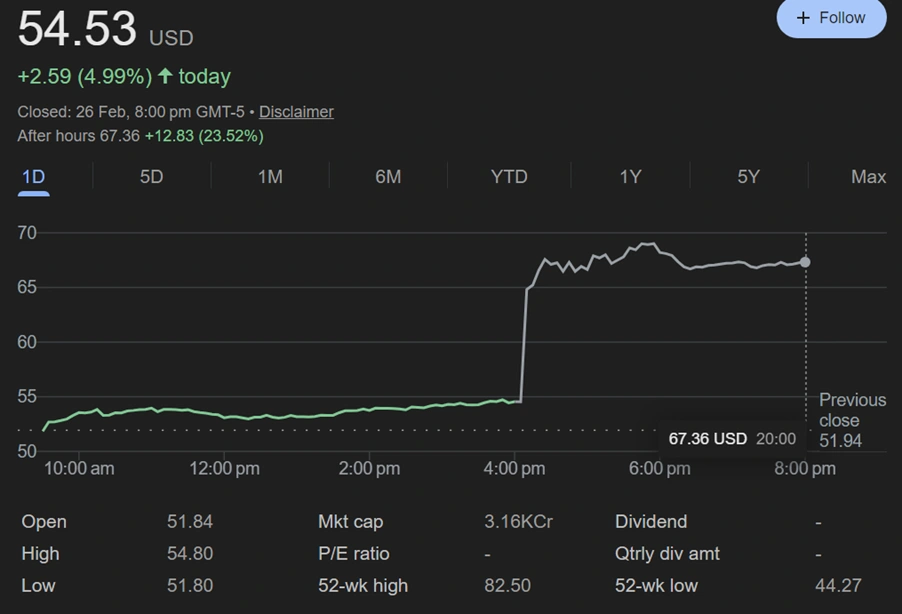
Block Price Chart [NYSE]
Block shares surged more than 20% in extended hours of trading after the announcement, with the stock having closed the regular session at USD 54.53 per share before the after-hours jump. Some reports put the peak after-hours gain closer to 24%.
The reaction reflects a broader market trend: investors are rewarding companies that demonstrate credible plans to reduce operating costs through AI, even when the human cost is significant.
Also Read: NVIDIA Just Posted the Biggest Year in Chip History. The Next One Looks Even Bigger.
What Comes Next for Block?
With the headcount reduction in motion, Block’s leadership will now face the task of proving the thesis, which means growing revenue and improving margins with a workforce less than half the size it was at its peak.
The company built its current employee base from 3,835 people at the end of 2019 to over 10,000 before Thursday’s announcement, a period that coincided with a surge in digital payments demand during and after the pandemic. Dorsey’s bet is that the same results, or better, are now achievable with far fewer people and far more automation.
Whether that plays out will become clear over the coming quarters. For now, the market has made its view plain.