
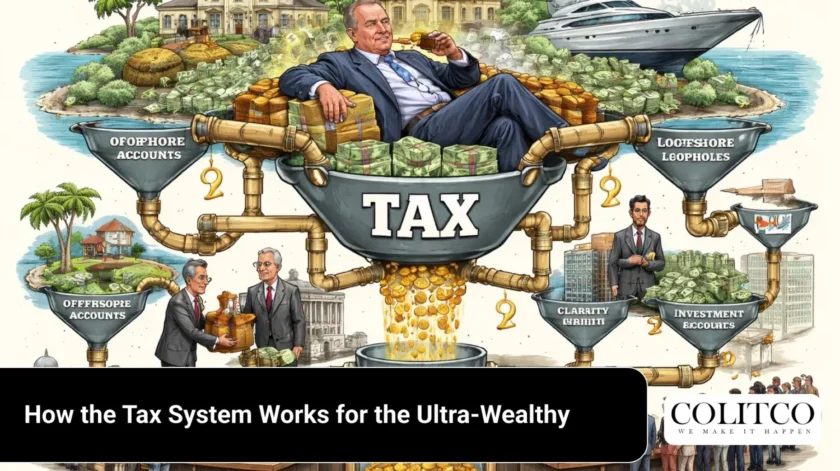
Most people dread tax season. For billionaires, it barely registers. That is not an accident. It is the result of a system that taxes income heavily but treats wealth very differently. Understanding how billionaires avoid taxes does not require a law degree. It just requires knowing where to look.

Figure 1: Tax planning concept illustrating how income and wealth are treated differently within modern tax systems [Freepik]
A study by professors at the University of California, Berkeley, found that the richest Americans pay an all-in tax rate that is 20% lower than the median American household. To put that in perspective, the median household has a net worth of approximately zero. Billionaires are paying a lower rate than that.
How the Tax System Treats Ordinary Earners?
For most people, income is simple. It comes in the form of a wage or salary, and the government taxes it on a sliding scale. In the United States, federal income tax starts at 10% and rises to 37% for the highest earners. On top of that, there are payroll taxes, state taxes and local taxes.
Take a married couple filing jointly with a gross income of US$110,000. After the 2025 standard deduction of US$31,500, their taxable income is US$78,500. The first US$23,850 is taxed at 10%, and the remaining US$54,650 at 12%. Their total federal tax bill comes to US$8,943, an effective rate of 8.13%. That is the taxes for the rich explained in contrast to how the rest of the system actually works.
How Billionaires Avoid Taxes Through the Realisation Principle
Here is where how billionaires avoid taxes starts to make sense. The ultra-wealthy do not primarily earn income. They accumulate wealth through appreciating assets such as stocks, real estate and ownership stakes in companies. Under the realisation principle, assets are only taxed when they are sold.

Figure 2: Filing a tax return highlights how ordinary earners are taxed primarily on wages and salaries [Freepik]
That means a billionaire whose net worth grows by billions in a single year may owe nothing in tax if no assets are sold. As Brian Galle, a professor of law at Berkeley, explained, individuals who make most of their money through investments get to choose when to pay tax, and one of those options is never. According to ProPublica, the top 25 billionaires in the US paid an effective tax rate of just 3.4%, even as their collective wealth grew by more than US$400 billion between 2014 and 2018.
A Three-Step Plan That Sidesteps Tax Entirely
The buy, borrow, die strategy is one of the most effective legal structures available to the ultra-wealthy. It works in three clear steps:
- Buy: Acquire appreciating assets such as stocks, businesses and property. These grow in value without triggering any tax
- Borrow: Use those assets as collateral to take out loans. Loan proceeds are not considered income, so no tax is owed. Meanwhile, the assets keep growing
- Die: Pass the assets to heirs with a step-up in cost basis. A lifetime of capital gains is wiped out, and no capital gains tax is ever due
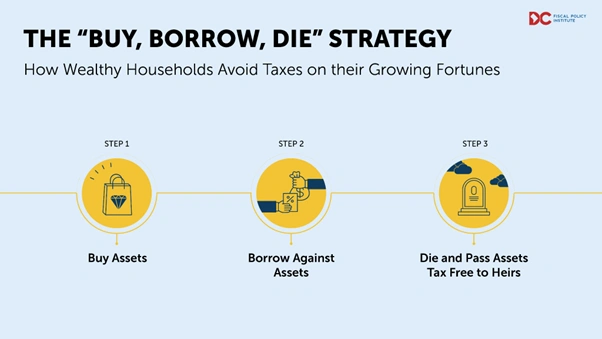
Figure 3: Overview of the “buy, borrow, die” strategy showing how wealthy households legally avoid capital gains taxes across generations [DC Fiscal Policy Institute]
As Galle explained, they acquire their assets, borrow money to sustain their lifestyle, and then die without ever paying any tax. This is how billionaires avoid taxes across generations.
Low Salaries, Capital Gains and the One-Dollar Trick
Another layer of taxes for the rich explained is through the compensation structure. Many billionaires accept minimal salaries, sometimes just US$1 per year. This keeps their reported income extremely low. When they do realise gains by selling assets, those gains are taxed at capital gains rates, which are generally lower than ordinary income tax rates.
The Berkeley study found that the richest 400 households in the US pay an effective tax rate of 24%, while the rest of the population pays around 30%. That inversion is largely explained by the gap between how wages and capital gains are taxed. Jeff Bezos is among those reported to have declared taxable income lower than some of the IRS agents who audit him.
The Global Push to Change This
The conversation around how billionaires avoid taxes is not just an American one. The Global Tax Evasion Report 2024, commissioned by Brazil’s G-20 presidency, recommended an annual 2% tax on individuals holding wealth exceeding US$1 billion. Economist Gabriel Zucman, who authored the report, argued that contemporary tax systems worldwide are effectively taxing the wealthiest individuals at rates of between 0% and 0.5% of their wealth.

Figure 4: Counting cash as a visual representation of how borrowed funds can be accessed without triggering taxable income [Freepik]
The proposal could potentially raise between US$200 billion and US$250 billion annually from approximately 3,000 individuals globally. Supporters include Brazil, France, Spain and the African Union. The United States has opposed the idea. The buy, borrow, die strategy and similar mechanisms sit at the centre of why this debate is not going away.
Can Ordinary People Use Any of These Strategies?
Most of what the ultra-wealthy do is not accessible to average earners. The structures require significant assets to begin with. That said, some principles do apply at a smaller scale:
- Maximise retirement account contributions to defer taxable income
- Donate appreciated stock to charity for a tax deduction without triggering capital gains
- Deduct depreciation, insurance and interest on investment property to reduce taxable income
- Harvest tax losses on underperforming assets to offset gains elsewhere
They are not the same as the buy, borrow, die strategy, but the underlying logic of deferring and reducing taxable events is the same. Understanding taxes for the rich, explained at this level, can help everyday investors make smarter decisions with what they have.
FAQ
Q1. How do billionaires avoid taxes legally?
Ans. They hold wealth in appreciating assets that are not taxed until sold, borrow against those assets for tax-free cash, and accept minimal salaries to keep reported income near zero.
Q2. What is the buy, borrow, die strategy?
Ans. Buy appreciating assets, borrow against them for tax-free cash, then pass them to heirs at death. The step-up in cost basis eliminates a lifetime of capital gains tax entirely.
Q3. What effective tax rate do the wealthiest Americans pay?
Ans. The richest 400 US households pay around 24%, while the rest of the population pays approximately 30%. The top 25 billionaires paid just 3.4% between 2014 and 2018.
Q4. What are taxes for the rich explained simply?
Ans. Wealth grows through assets, not salaries. Assets are only taxed when sold. By never selling and borrowing instead, billionaires generate cash with little to no taxable income.