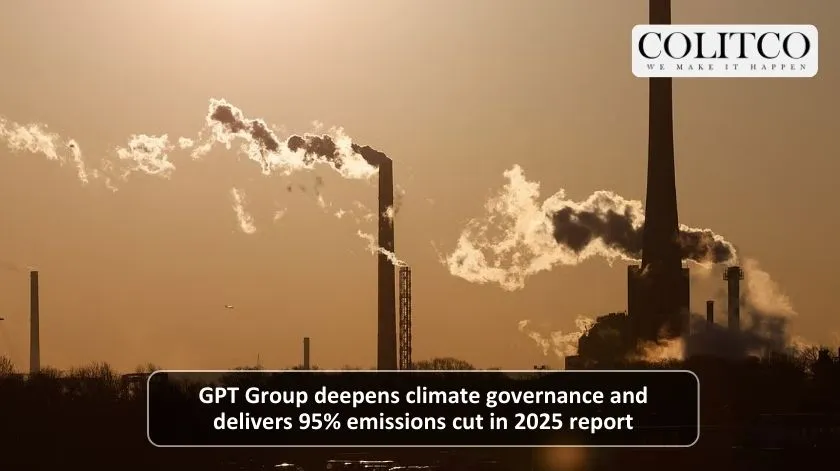
GPT Group has tightened board oversight, accelerated decarbonisation and expanded its focus on nature-related risks, as the property giant released its 2025 Climate and Nature Disclosure Statement.
The diversified real estate investment manager, which oversees $36.6 billion in assets across retail, office, logistics and living sectors, has positioned climate and biodiversity risk at the centre of its governance, capital allocation and long-term asset strategy.
The report outlines measurable progress, and it shows GPT has moved well beyond high-level pledges.
Read the full announcement Here.
Emissions fall sharply as electrification and renewables scale up
GPT has reduced absolute Scope 1 and 2 emissions by 95% since its 2019 baseline. It has also cut emissions intensity by 94% over the same period.
In 2025, GPT reported:
- Scope 1 emissions of 7,874 tCO₂e
- Scope 2 emissions (location-based) of 72,365 tCO₂e
- Scope 2 emissions (market-based) of 10,080 tCO₂e
- Net Scope 1 and 2 emissions (market-based) of 4,579 tCO₂e
- Net Scope 1 and 2 intensity of just 3 kgCO₂e per square metre
The group drove these results through renewable electricity procurement, electrification of building systems and continued efficiency upgrades across its portfolio.
GPT has now installed 15.5MW of solar PV capacity across its owned assets, strengthening on-site renewable generation and reducing exposure to grid volatility.
Management has acknowledged that refrigerant use increased during the year due to maintenance activities, which influenced some year-on-year Scope 1 figures. Even so, the longer-term decarbonisation trend remains firmly downward.
Sustainable finance links capital to climate performance
GPT has reinforced its climate strategy through capital management.
By the end of 2025, GPT and the GPT Wholesale Office Fund had issued $1.3 billion in combined debt under the group’s Sustainable Debt Framework. The framework ties funding to environmental performance metrics and signals discipline to institutional investors who demand credible ESG integration.
Management has made clear that it views climate risk as a financial risk. The group now embeds climate considerations directly into investment decisions, development approvals and asset repositioning strategies.
100% asset review for climate vulnerability
GPT has completed climate vulnerability assessments across 100% of its owned assets, including development sites.
The company has also implemented climate adaptation plans across all wholly owned and managed office and retail assets.
Asset teams have analysed exposure to extreme heat, flooding, storm events and other physical climate risks. They have then prioritised mitigation measures, capital works and operational adjustments to strengthen resilience.
GPT integrates scenario analysis into enterprise risk management, allowing leadership to test portfolio performance under different warming pathways and transition settings. The Board oversees this process and reviews performance against targets.
Nature strategy expands beyond carbon
The 2025 report broadens the focus from emissions to ecosystems.
Through its Restoring Country for Climate partnership, GPT supported the sequestration of 105,575 tonnes of carbon dioxide equivalent during 2025.
The group also:
- Achieved 34% closed-loop recycling
- Reviewed 99% of its assets for biodiversity, stormwater and heritage interfaces
GPT has embedded biodiversity considerations into development planning and water management strategies, particularly across retail and logistics precincts where land use and runoff management carry higher environmental exposure.
Management recognises that biodiversity loss, water stress and urban heat affect asset values, insurance costs and tenant demand. By expanding its nature disclosures, GPT has aligned with emerging global expectations around nature-related financial risks.
Also Read: Aurizon Holdings Limited lifts dividend as earnings surge
Governance takes centre stage
GPT’s Board retains oversight of climate and nature-related risks. Management integrates sustainability metrics into performance frameworks and long-term planning.
The group aligns reporting with global disclosure standards and continues to refine data collection and transparency. It measures progress against its 2019 baseline and publishes both absolute and intensity metrics to provide clarity for investors.
Rather than treating sustainability as a compliance exercise, GPT has embedded it into strategy.
What this means for investors
GPT’s latest disclosure signals discipline and forward planning in a property market that faces regulatory tightening, physical climate volatility and shifting tenant expectations.
The group has:
- Nearly eliminated operational emissions since 2019
- Linked sustainability outcomes to financing
- Completed portfolio-wide climate risk assessments
- Expanded into biodiversity and nature risk management
Shares last traded at $5.07, up 0.80% on the day. Over the past year, the stock has returned 9.03%, outperforming the broader ASX 200.
Investors now weigh more than rental growth and asset revaluations when assessing listed property vehicles. They assess resilience, transition readiness and exposure to physical climate risk.
GPT’s 2025 Climate and Nature Report demonstrates that the group has responded decisively. It has reduced emissions at scale, strengthened governance and broadened its environmental lens.
For long-term investors, that combination may offer something increasingly valuable in property markets: durability.