National security of drones has ceased as a niche procurement to a national emergency issue in the Western defence markets. Bases, borders and critical infrastructure are now being threatened by cheap unmanned aircraft on a daily basis. Military units are thus pursuing layered counter-drones that identify, monitor, and neutralise enemy machines in a quick manner.
Once such contracts are at hand reveal how well-organised purchasing structures can be used to make every buying decision. This dynamic is demonstrated by the case of DroneShield Ltd when it clinched 6 contracts valued at 21.7 million with a military client in the West.
The dismounted counter-drone systems, spares, and software are covered by the package, and the delivery will be completed in the first quarter of 2026. It is anticipated to be paid in the second quarter of 2026. These statistics illuminate consistent demand for verified anti-drone technology through defence funds.
Governments have shifted to viewing drone defence as a form of cybersecurity, where the government needs to upgrade the technology every time and have the capability of deploying it promptly.
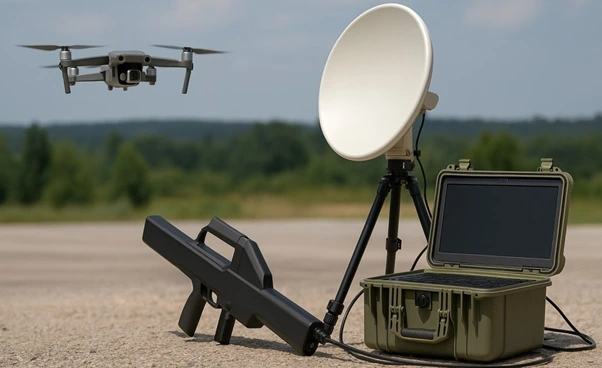
Portable counter-drone tools allow soldiers to disrupt hostile drones during field operations. [Fly eye]
How Does Government Drone Security Shape Procurement Criteria?
Defence customers do not buy equipment on headline assertions very often. They adhere to the stringent capability matrices determining the range of detection, response time, and reliability of operations.
Government drone security force personnel initially determine the threat situations based on intelligence data and reports from the battlefield. Then they put counter-drone systems against small quadcopters and larger fixed-wing platforms.
Systems should be interconnected with the available radar, command software and communications connections. At the last scoring, interoperability usually prevailed over flashy specifications. The cost efficiency issue is also important, but the lifecycle value weighs more than the sticker price.
Purchasers look at the maintenance requirements, access to spare parts, and training requirements. The reason why software support contracts are evaluated is the fact that threats keep on changing at an alarming rate. Vendors that provide updates and analytics benefit.
The compliance with export rules and cyber standards is also reviewed by the procurement officers. This is a disciplined method of minimising risk and guaranteeing that the taxpayers’ financial equipment works every time.
Field Testing Determines Real-World Performance
Lab findings are not that likely to be successful on the battlefield. Governments thus do live demonstrations in real situations prior to making contracts. Counter-drone systems are implemented by engineers in diverse geographies, such as cities and desert areas.
They replicate signal jamming, environmental pressure and ESD. The operators measure detection speed, jamming accuracy, and system uptime.
The failures are recorded and discussed with vendors on an immediate basis. Based on performance, only the equipment that is sustaining is procured. This step underlines the reason why repeat orders are usually won by established suppliers.
The latest package of the 21.7 million that DroneShield sourced was through an in-country reseller who has a past delivery worth 17.8 million in the last seven years. Such history means trust and logistical reliability. Field testing, therefore, transforms technical promises into quantifiable operational evidence.

Defence teams run live trials to validate detection, tracking, and jamming reliability. [OPAL-RT]
Contracts Reward Proven Counter-Drone Systems
The defence agencies prefer suppliers that have working stocks and on-demand delivery schedules. Here, all the ordered items are in stock. Such preparedness minimises the lead time and lowers the risk of deployment.
Spare kits and software subscriptions are also part of the contracts to increase the lifespan of the system. The subscription models assist in regular upgrades against threats that emerge.
This structure is perceived by the procurement officers as a hedge against obsolescence. A large number of governments now want to get modular counter-drone systems that can be expanded to patrol units up to base defence.
This flexibility promotes military collaboration and the use of force across borders. Winning vendors thus are not only technology demonstrating but also supply chain resilient.
Payments are to be made in stages, and cash flow is correlated with milestones and acceptance tests. This would shield the public money and compensate for punctual performance.
What Risks Do Governments Assess Before Approval?
Risk assessment determines all major purchases. Governments weigh financial security, export policies and reliance on one supplier. They also determine anti-drone technology vulnerabilities to cyber attacks.
Any system connected to the network may fall victim to it. Another risk factor is training demands. Machines that involve highly skilled personnel raise long-term expenses. Decision-makers thus like interfaces that are intuitive and have low learning curves.
The law also applies in terms of disabling civilian or commercial drones. There should be clear regulations of engagement. Lastly, officials believe in the political sensitivity concerning the disclosure of end-users.
In the new contracts, the counterparty works as an intermediary distributor to the Western military customer. Security valuations are not likely to be influenced by the customer identity. This is a typical kind of confidentiality in defence trade.

Secure logistics, cyber protection, and training readiness influence approval decisions. [AFP Global Logistics]
Government Drone Security Budgets Signal Long-Term Growth
According to market indicators, there will be long-term growth in defence expenditures on the protection of drones. Small unmanned threats are inexpensive and universal. The counter-measures should therefore be nimble and cost-effective.
Analysts anticipate that the demand for counter-drone systems in the world is going to continue increasing throughout the decade. The high defence relations might help companies in gaining repeat orders and services.
The performance of stock drones of DroneShield, which went up by 299 per cent in the last 12 months, greatly surpassed 11 per cent of the S&P/ASX 200 Index. Although the past returns may not be indicative of the future, they show investor confidence in anti-drone technology.
In the case of governments, the priority is still evident. National resilience is now based on effective protection. Systematic analysis is necessary so that every dollar is funding reliable and mission-capable abilities.
Also Read: ASX:DRO Gets Major Lift After DroneShield Clinches A$6.2M Regional Defence Order
FAQs
- What is Government drone security?
Ans: It refers to strategies and technologies that protect assets from hostile unmanned aircraft.
- How do counter-drone systems work?
Ans: They detect, track, and disrupt drones using radar, sensors, and electronic interference.
- Why are field trials important before purchase?
Ans: Trials prove reliability under real conditions and reduce procurement risk.
- Do contracts usually include software updates?
Ans: Yes, subscriptions keep anti-drone technology effective against evolving threats.