Global stock markets traded unevenly on February 24 as investors assessed renewed tariff uncertainty and rising concerns about artificial intelligence disrupting key industries. Asian equities advanced, European markets edged lower, and U.S. stock futures pointed to a modest rebound after sharp losses on Wall Street.
The mixed performance followed a broad selloff in U.S. equities on February 23. Market participants reacted to new U.S. tariff announcements and fresh research highlighting potential economic risks linked to AI adoption. The combination of trade policy confusion and technology sector anxiety reshaped short-term risk appetite across global markets.
Wall Street Slides as Dow, S&P 500 and Nasdaq Fall Over 1%
U.S. equities closed lower on Monday, with all three major indexes declining by more than 1%. The Dow Jones Industrial Average dropped about 820 points, or 1.7%, to 48,804. The S&P 500 fell 1.04%, while the Nasdaq Composite declined 1.13%.
Technology and financial stocks led the retreat. Investors reduced exposure to software and AI-related companies after a widely circulated research report outlined downside scenarios tied to rapid automation. The CBOE Volatility Index rose above 21, reflecting increased caution.
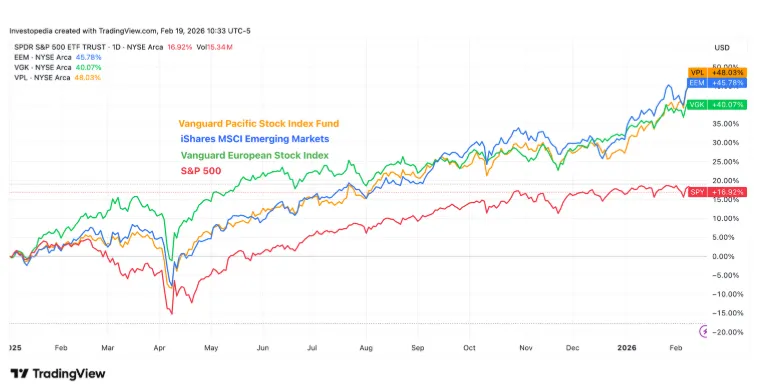
U.S. indexes fell sharply amid renewed tariff and AI concerns. [Investopedia]
IBM shares fell more than 13% after reports that an AI startup introduced tools capable of modernising legacy code systems. The development raised questions about competitive positioning within the enterprise software market. Analysts noted that heavy concentration in AI-linked names has increased short-term market sensitivity to negative headlines.
Asian Markets Rebound While European Shares Trade Lower
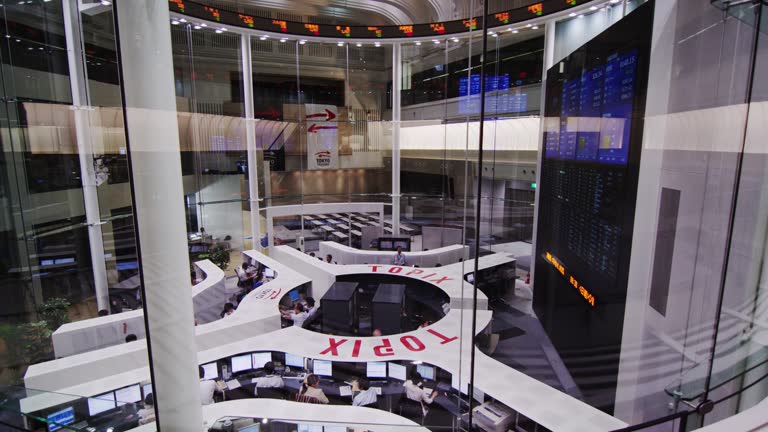
Asian equity markets recovered on Tuesday as investors reassessed the prior session’s decline. Chinese markets gained around 1% after reopening from a holiday. Japan’s Nikkei 225 and South Korea’s Kospi also advanced, supported by technology and export stocks.
The Japanese yen weakened against major currencies, yet equity investors focused on domestic earnings momentum. China’s yuan strengthened to its highest level in nearly three years versus the U.S. dollar, signalling relative currency stability in the region.
Asian equities gained as investors reassessed prior session losses. [Getty images]
European markets moved in the opposite direction. The pan-European STOXX 600 slipped about 0.1% in mid-morning trading. Banking stocks declined roughly 1.6%, tracking weakness seen on Wall Street. Utilities and defensive sectors outperformed as investors sought stability.
The UK’s FTSE 100 remained broadly flat, declining only 0.02% in the previous session. Gains in mining stocks helped offset losses in trade-sensitive sectors. However, trading volumes remained moderate as investors awaited clearer policy direction from Washington.
Trump Tariff Announcements Add to Trade Policy Uncertainty
Trade policy developments intensified market volatility. The U.S. Supreme Court recently struck down large parts of President Donald Trump’s emergency tariff framework. In response, the administration announced plans to impose a 15% tariff on all imports for a temporary 150-day period.
The change replaced a previously announced 10% rate. However, officials did not clarify implementation timelines, which created uncertainty for importers and exporters. Market participants struggled to price the potential economic impact.

New U.S. tariff measures create uncertainty for global trade and investors. [britannica]
Reuters reported that some importers could qualify for tariff refunds. Shipping and logistics firms began reviewing exposure to revised trade measures. China stated that it was closely monitoring U.S. policy, while European officials expressed concern about compatibility with existing trade agreements.
Strategists noted that sudden shifts in tariff rates complicate corporate planning and earnings forecasts. Deutsche Bank analysts indicated that effective tariff levels could eventually stabilise, yet markets have not fully absorbed the implications.
AI Disruption Concerns Pressure Technology and Financial Stocks
Beyond trade policy, artificial intelligence remains a major driver of equity volatility. Investors questioned whether rapid AI deployment could disrupt established business models across software, payments and financial services.
Research circulating over the weekend outlined potential downside risks if AI adoption accelerates faster than revenue adaptation. As a result, investors reduced exposure to companies viewed as vulnerable to technological displacement.

Rapid AI adoption drives volatility in technology and financial stocks. [Traders Union]
Semiconductor stocks also faced pressure ahead of Nvidia’s earnings report scheduled for February 25. Nvidia accounts for roughly 8% of the S&P 500’s total weighting. Market participants expect earnings guidance to influence broader sentiment toward AI investment trends.
In Europe, financial institutions declined as analysts examined how AI tools could reshape banking operations. Defensive sectors such as utilities and consumer staples attracted inflows, reflecting a shift toward lower-volatility assets.
Commodities and Safe-Haven Assets Reflect Investor Caution
Commodity markets signalled mixed risk sentiment. Brent crude oil traded near seven-month highs around $71 per barrel. Traders cited geopolitical tensions and upcoming U.S.-Iran nuclear discussions as factors supporting prices.
Energy equities showed varied performance. Integrated oil companies held steady, while airline shares fell approximately 3.8% amid weather disruptions and higher fuel costs.
Gold attracted renewed safe-haven demand. Spot prices rose more than 2% to around $5,200 per ounce on Monday, reaching the highest level since late January. Gold futures settled nearly 2.8% higher. Precious-metal mining stocks advanced alongside bullion.

Gold and oil reflect investor caution amid market volatility. [Istock]
Silver also gained, reflecting broader demand for non-equity assets. By Tuesday’s Asian session, gold eased slightly to about $5,166, though analysts indicated that unresolved trade tensions could sustain elevated prices.
U.S. Treasury yields remained near recent lows. The two-year yield hovered around 4.4% as investors weighed Federal Reserve commentary and safe-haven flows. Currency markets showed limited volatility outside of yen weakness and yuan strength.
Economic Data and Key Events in Focus
Amid market volatility, U.S. economic data provided mixed signals. The Conference Board reported that consumer confidence rose to 91.2 in February, up from 89.0 in January. Economists had expected a decline. The labour-market index improved modestly, suggesting steady employment conditions.
The U.S. unemployment rate stood at 4.3% in January. While inflation concerns persist, recent labour data indicate resilience in household spending capacity. Analysts noted that stable employment could cushion near-term economic risks.
Looking ahead, markets will monitor President Trump’s upcoming State of the Union address for clarity on trade and fiscal policy. Investors will also focus on Nvidia’s earnings release, along with results from major corporations in technology and retail sectors.
Federal Reserve officials are scheduled to speak later in the week, and inflation data are due in early March. These events could influence expectations for interest rates and monetary policy direction.
Also Read: BHP Shares Hit Record High on FY26 Earnings
Market Outlook: Risk Reassessment Continues
Global equity markets remain sensitive to trade developments and AI-related uncertainty. Investors continue to rebalance portfolios toward defensive assets while maintaining selective exposure to growth sectors.
Tariff policy adjustments, technology earnings results and geopolitical negotiations will likely shape short-term volatility. Until clearer signals emerge, analysts expect markets to remain reactive to headlines and data releases.
For now, stock markets reflect a cautious stance. Asian gains show selective optimism, while U.S. and European markets reveal underlying risk reassessment. Investors continue to evaluate how trade shifts and AI transformation may influence earnings across sectors in 2026.
FAQs
- Why are global stock markets mixed right now?
Global stock markets are mixed due to renewed uncertainty around U.S. tariff policy and rising concerns about the economic impact of artificial intelligence. Investors are reacting to trade developments and volatility in technology stocks.
- How are U.S. tariffs affecting stock markets?
New tariff announcements have increased uncertainty for businesses and investors. Higher import duties can raise costs for companies, disrupt supply chains, and reduce profit expectations, which often pressures equity markets.
- Why are AI fears impacting tech stocks?
Investors worry that rapid AI development could disrupt established business models in software, finance, and technology sectors. Research highlighting competitive risks has led to selloffs in AI-exposed stocks.
- Which stock markets performed best during the recent volatility?
Asian markets showed relative strength, with gains in China, Japan, and South Korea. Meanwhile, U.S. and European markets experienced declines, particularly in technology and banking sectors.
- Why did gold prices rise during market uncertainty?
Gold often acts as a safe-haven asset during periods of economic or geopolitical uncertainty. Investors increased gold holdings as stock market volatility and tariff concerns intensified.
- How do tariffs impact global trade and economic growth?
Tariffs can increase costs for importers and consumers, reduce cross-border trade volumes, and create uncertainty in corporate investment decisions. These factors may slow economic growth if trade tensions persist.
- What should investors watch next in global markets?
Investors are closely monitoring corporate earnings, especially from major AI-related companies, as well as updates on U.S. trade policy, inflation data, and Federal Reserve guidance.