
Global investors pour capital into the mining sector as 2026 begins. Resource companies report record earnings across multiple commodity groups. Market analysts track a significant surge in valuations for Australian and international miners.
Commodity Prices Reach Historic Levels
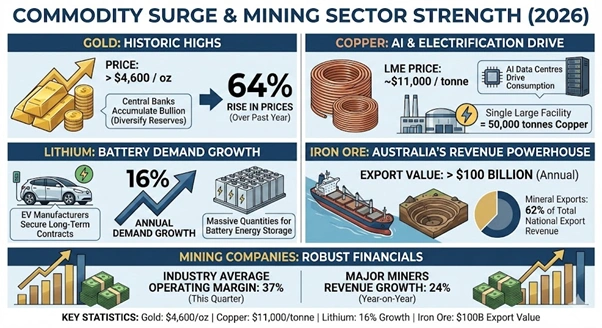
The price of gold recently surpassed $4,600 per ounce. Central banks continue to accumulate bullion to diversify reserves. This demand supports a 64 per cent rise in gold prices over the past year.
Copper prices currently trade near $11,000 per tonne on the London Metals Exchange. Data centres for artificial intelligence drive this consumption. A single large facility requires 50,000 tonnes of copper for electrical systems.
Lithium demand grows by 16 per cent annually. Electric vehicle manufacturers secure long-term supply contracts with miners. Battery energy storage systems also require massive quantities of lithium and graphite.
Iron ore remains a primary revenue source for the Australian economy. Mineral exports now contribute 62 per cent of total national export revenue. Iron ore alone generates more than $100 billion in annual value.
Mining companies maintain high profit margins during this cycle. The industry average operating margin reached 37 per cent this quarter. Revenue for major miners grows at 24 per cent year-on-year.
- Gold: $4,600 per ounce
- Copper: $11,000 per tonne
- Lithium: 16% annual demand growth
- Iron Ore: $100 billion export value
Commodity prices reach historic levels
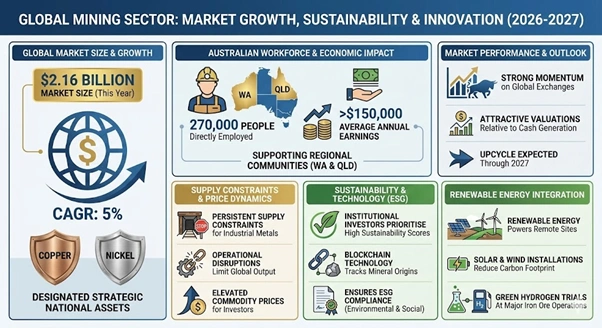
The global mining market size will reach $2.16 trillion this year. This represents a compound annual growth rate of 5 per cent. Governments designate copper and nickel as strategic national assets.
Australia employs 270,000 people directly within the resources sector. Average annual earnings in the industry exceed $150,000. These wages support regional communities across Western Australia and Queensland.
The sector demonstrates strong momentum on global stock exchanges. Valuations remain attractive relative to cash generation potential. Analysts expect the upcycle to continue through 2027.
Supply constraints persist for several industrial metals. Operational disruptions at major mines limit global output. These shortages keep commodity prices at elevated levels for investors.
Institutional investors prioritise companies with high sustainability scores. Miners implement blockchain technology to track mineral origins. This transparency ensures compliance with environmental and social regulations.
Renewable energy now powers many remote mining sites. Solar and wind installations reduce the carbon footprint of extraction. Green hydrogen trials begin at several major iron ore operations.
Global mining sector: Australian workforce and economic impact
Strategic Investments and Technological Shifts
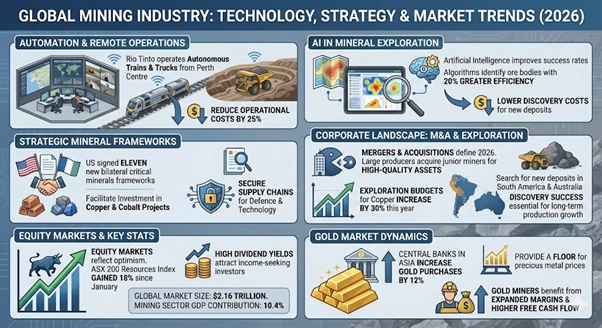
Mining firms allocate capital toward automation and remote operations. Rio Tinto operates autonomous trains and trucks from a Perth centre. These systems reduce operational costs by 25 per cent.
Artificial intelligence improves mineral exploration success rates. Algorithms identify ore bodies with 20 per cent greater efficiency. This technology lowers the cost of discovering new mineral deposits.
The United States signed eleven new bilateral critical minerals frameworks. These agreements facilitate investment in copper and cobalt projects. This diplomacy aims to secure supply chains for defence and technology.
Mergers and acquisitions define the corporate landscape in 2026. Large producers acquire junior miners to secure high-quality assets. These consolidations unlock synergies and increase shareholder value.
Exploration budgets for copper increase by 30 per cent this year. Companies search for new deposits in South America and Australia. Success in discovery remains essential for long-term production growth.
Equity markets reflect this optimism through higher share prices. The ASX 200 Resources Index gained 18 per cent since January. High dividend yields attract income-seeking investors to the sector.
- Autonomous vehicles reduce costs by 25%
- AI exploration improves efficiency by 20%
- Global market size: $2.16 trillion
- Mining sector GDP contribution: 10.4%
Central banks in Asia increase gold purchases by 12 per cent. These acquisitions provide a floor for precious metal prices. Gold miners benefit from expanded margins and higher free cash flow.
Artificial intelligence improves mineral exploration success rates
Nickel production remains critical for high-performance electric vehicle batteries. Supply from Indonesia continues to dominate the global market. Australian miners focus on high-grade sulphide deposits for battery chemistry.
Metal recycling also gains traction among major mining firms. Companies invest in facilities to recover copper and aluminium from scrap. This circular economy approach supplements primary extraction methods.
Water management becomes a primary focus for operational efficiency. Miners install desalination plants and water recycling systems at sites. These investments mitigate risks associated with regional droughts.
The global energy transition requires unprecedented volumes of silver. Photovoltaic cells consume 15 per cent of annual silver production. Silver prices have responded with a 22 per cent increase this year.
Safety standards improve through the use of remote monitoring. Drones inspect high-risk areas without exposing personnel to danger. These advancements reduce lost-time injuries by 40 per cent globally.
Future Outlook and Market Stability
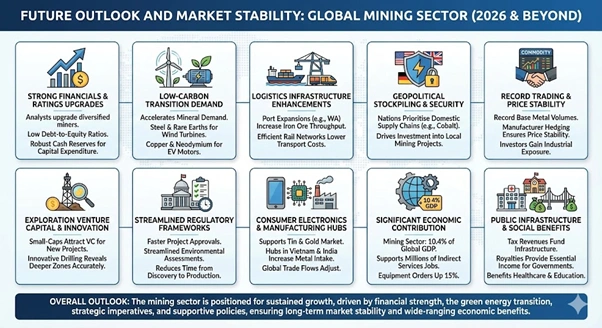
Financial analysts upgrade their ratings for diversified mining companies. Balance sheets remain strong with low debt-to-equity ratios. Robust cash reserves allow for consistent capital expenditure programs.
The transition to a low-carbon economy accelerates mineral demand. Wind turbines require large quantities of steel and rare earth elements. Electric motors rely on high-purity copper and neodymium magnets.
Logistics infrastructure improvements enhance the delivery of bulk commodities. Port expansions in Western Australia increase iron ore throughput capacity. Efficient rail networks lower the unit cost of mineral transport.
Geopolitical tensions influence the strategic stockpiling of essential minerals. Nations prioritise the security of domestic supply chains for cobalt. This trend drives investment into local mining projects.
Commodity exchanges report record trading volumes for base metals. Hedging activities by manufacturers ensure price stability for end-users. Investors utilise these markets to gain exposure to industrial growth.
Small-cap exploration companies attract venture capital for new projects. Innovative drilling techniques reveal deeper mineralised zones with accuracy. These discoveries provide a pipeline of future mining operations.
Regulatory frameworks evolve to support faster project approvals. Governments streamline environmental assessments for critical mineral projects. This policy shift reduces the time from discovery to production.
Consumer demand for electronics supports the market for tin and gold. Manufacturing hubs in Vietnam and India increase their metal intake. Global trade flows adjust to these changing industrial landscapes.
The mining sector contributes 10.4 per cent to the global GDP. This economic impact supports millions of indirect jobs in services. Equipment manufacturers see a 15 per cent rise in new orders.
Tax revenues from mining activities fund public infrastructure projects. Royalties provide essential income for state and federal governments. This wealth distribution benefits the healthcare and education sectors.
Future outlook and market stability
Stock market volatility remains low for established resource companies. Consistent earnings provide a stable foundation for investment portfolios. Long-term trends favour the continued expansion of the mining industry.
Technological integration reaches new levels with the industrial internet. Connected sensors monitor equipment health to prevent unplanned downtime. Predictive maintenance saves companies millions in repair costs annually.
Environmental restoration efforts become more sophisticated at closed mines. Native vegetation replanting programs restore biodiversity to local ecosystems. Companies allocate significant funds for long-term site rehabilitation.
The 2026 mining surge highlights a critical shift toward a greener, tech-driven economy. These gains reflect the sector’s essential role in powering future infrastructure and innovation. This trend offers a compelling case for the industry’s long-term value and stability.