This debate on the growth of the Australian economy and GDP was intensified with new figures of deficits fanning the political row in Canberra, with the senior opposition figures accusing the government of covering up the fiscal pressures and the ministers trying to justify spending as responsible and targeted.
Deputy Liberal leader Jane Hume condemned the Labour budget story and told the Liberals that future deficits were not credible, and Treasurer Jim Chalmers denied the allegations and said the government strategy cushioned households amidst recalcitrant inflation.
However, the dispute has brought back into question the meaning of GDP growth and the impact of the GDP growth on the economy, to both families, investors, and businesses struggling with increased costs and slow activity.
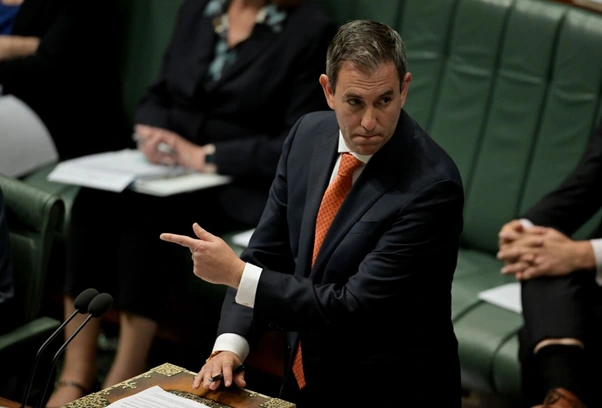
Budget tensions in Canberra go up as leaders argue over deficits and economic credibility. [Bloomberg]
Labour Deficit Figures Trigger Political Backlash
The Albanese federal budget has been estimated by the Albanian government to be 14bn deeper in the red, had the Coalition won the 2025 election, which heightens questioning of rival fiscal policy and economic governance.
Official comparisons indicated that the Mid-Year Economic and Fiscal Outlook of Labour recorded a deficit of $36.8bn, with the Coalition estimating a deficit of 47.8bn in 2025-26, giving an 11bn deficit.
That gap is reduced to $3bn in 2026-27, which would still put the budget worse under the opposition plan as per government figures. Opponents say that this expansion of deficits is dangerous to the growth of GDP and stability of the economy because it spawns inflation and strains interest rates.
How Do The Numbers Shape GDP Growth’s Meaning For Voters?
To voters, the meaning of the GDP growth is usually reduced to jobs, wages and prices as opposed to abstract numbers; however, the deficit settings may affect all these by the way the government spends and the level of borrowing.
Senator Hume informed Sky News that the numbers did not matter and the Treasurer concentrated on the forecasts rather than actual results.
She claimed that a sustained high level of government expenditure would put inflation at a more extreme level, and this would reduce consumption and retard investment in the private sector.
Economists observe that as the rate of borrowing soars, the yield on bonds may go up, and this increases the cost of capital, which impacts the way in which GDP growth influences the economy in diverse sectors.
The actual effect of inflation and slower growth is being experienced by households and businesses. [Bankrate]
Coalition Calls For Spending Restraint
Spending restraint has been identified as a key part of their economic agenda by Opposition Leader Angus Taylor and Senator Hume, and they have indicated that a future government will reevaluate the costs of programs and the growth of the public service.
They suggested a bipartisan task force to come up with good savings, with the argument that a lean government can facilitate greater expansion in the private sector. The government declined this proposal, terming it as political theatre and not a constructive policy.
This conflict brings out antagonistic philosophies where one side favours stimulus and the other favours consolidation to stabilise GDP growth and economic states.
Could Spending Cuts Protect Households From Inflation?
The proponents of stricter budgets argue that a decrease in expenditure would reduce demand pressures and would put a check on inflation that would help in reducing the interest rates and assist mortgage borrowers nationwide.
But ministers say that such significant cuts will jeopardise basic services, like defence, aged care and social support, which Finance Minister Katy Gallagher has called high priority. Opposition personalities have never excluded the idea of cutting the public service, an idea that was linked to Peter Dutton before.
The equilibrium between restraint and protection has been at the core of the impact of GDP growth on the economy for ordinary Australians.
Spending cuts ease inflation, lower rates, and support mortgage holders. [The Economics Times]
Economic Credibility Remains At The Centre Of Debate
Treasurer Chalmers called the strategy of the opposition reckless and stated that their numbers suggested an increase in taxes, deficits and debt, whereas the management of Labour was measured and responsible.
According to him, stable policy environments are required to cushion the standard of living and regain faith in the GDP growth and economic prospects.
The opposition argued that the unchecked spending affects the purchasing power and leaves the Australian poor in the long run.
As both sides dump on each other, the fiscal discipline will be a focus of the investors as Australia seeks to negotiate slower global demand and domestic pressures on costs.
Also Read: Slower Than Expected: Australia’s Economy Delivers Mixed Signals as GDP Growth Lags Forecasts
FAQs
Q1: What does the GDP growth mean in simple terms?
A1: It measures how much the economy’s total output increases over time.
Q2: How does GDP growth affect the economy for households?
A2: Higher growth can mean more jobs, wages and stable prices.
Q3: Why do deficits matter for GDP growth and the economy?
A3: Large deficits may raise borrowing costs and fuel inflation pressures.
Q4: What policies can improve growth prospects?
A4: Balanced spending, productivity reforms and private investment support stronger expansion.