
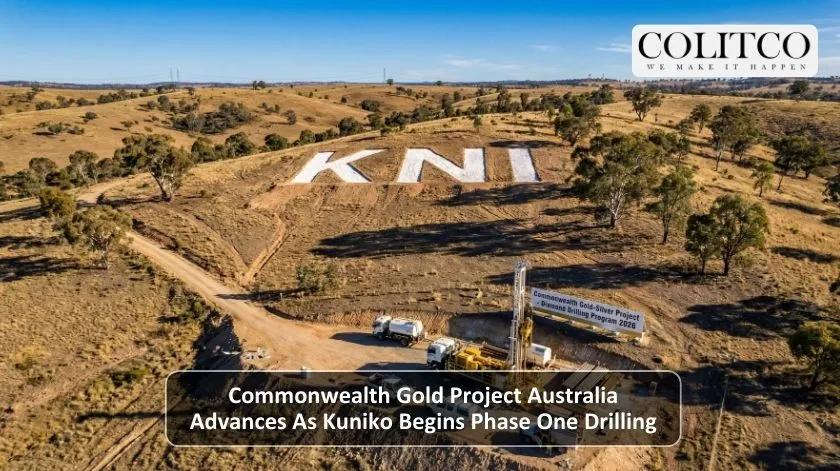
Kuniko is planning the phase one drilling at the Commonwealth Gold Project in Australia, in New South Wales. Mobilisation will commence on 11 February 2026, and this will be a big milestone in the exploration endeavours of the company.
The first campaign will be aimed at drilling 1,200m of priority prospects. The program is perceived by management as one of the high-impact steps towards the definition of new resources.
The project lies in an efficient Lachlan Fold Belt, which is a depository of several key deposits. Gold and silver systems are in this geological environment. As the level of activity intensifies, investors are keeping a watch.
The campaign will focus on a rapid increase in known mineralisation. The firm has the impression that superficial objectives may expedite the discovery periods. The untimely execution will create continuity of news flow.
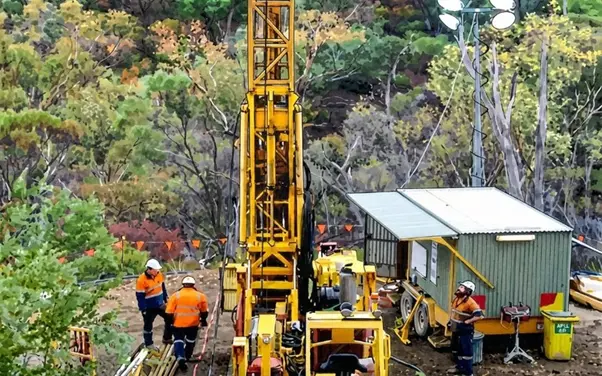
Drilling mobilisation commences through the Commonwealth exploration corridor in New South Wales. [Small Caps]
Commonwealth Gold-Silver Project Drilling Targets Multiple Prospects
The program targets extensions of known mineralisation of Silica Hill, Commonwealth Main and Commonwealth South.
The prospects already have favourable historical grades. There are possibilities of strike and depth development in each place. The plan formed by the company was to give maximum coverage during the initial phase.
The drilling will also be used to test structural controls and continuity. The purpose of step-out holes is to verify scale potential. Geophysical reactions will inform the location of holes.
The strategy strikes a balance between discovery and resource definition. This design helps to make quicker technical decisions. The increased Commonwealth Gold-Silver Project footprint offers district-level upside.
How Significant Are Historical Results At Commonwealth Main?
Commonwealth Main is also a high-priority target for drilling shortly. The team will test down-plunge extensions to the mineralisation of known mineralisation.
Structural interpretations indicate continuity that is less than past hits. Past drilling had yielded 7m 6.3 grams per tonne gold, 496g/t silver, 7.2% zinc, 2.9% lead, and 0.2% copper at a depth of 91m.
These intersections indicate that there is great polymetallic potential. The management reckons that additional drilling would increase the footprint at a fast rate.
The system is open on both strike and depth. These properties usually facilitate the development of resources. The company considers this zone as a foundation of future estimates.

Commonwealth Main has good gold and silver mineralisation as depicted by historical core samples. [Earth.com]
Silica Hill Step-Out Work Supports Broader Resource Growth
Step-out drilling will be done to explore down-dip and along-strike extensions at Silica Hill. Positioning of holes will be guided by coincidental geophysical anomalies. The strategy enhances the efficiency of targeting and minimises the risk of exploration.
Past surface and underground excavation showed continuation. The team will be interested in determining whether the mineralisation will extend beyond the stipulated limits. Victory would bring in tonnage.
Drilling is also cheaper in shallow depths. The shortening of turnaround time favours swifter updates in the market. The prospect complements the Commonwealth Main results. The combination makes the case of the project even better.
Will Commonwealth South Extend The Mineralised Corridor?
Commonwealth South testing will test the mineralised extension to the south. Historical drilling provided strong grades on a short-term basis. Older campaigns yielded 7m 25.5g/t gold, 62g/t silver, 3.8% zinc, 1.6% lead and 0.1% copper, at 88m.
These findings signify the high localised enrichment. Scale and continuity will be evaluated by the use of new holes. The corridor may become very large in case mineralisation is connected with other prospects.
The program will be handled by contractors of Titeline Drilling. It is well supported in the execution of drilling. The phase is projected to bring about stable operational development in the company.

Contractors assemble rigs to test southern extensions in Commonwealth South. [Offshore Technology]
Commonwealth Gold Project Australia Moves Into High-Impact Stage
Kuniko explains the future drilling as a transformational phase to the Commonwealth Gold Project in Australia. One of the avenues of growth of resources, as pointed out by Managing Director Maja McGuire, is the shallow, high-grade gold-silver system.
The intercepts in history ensured fertility in various vistas. The company has high prospects of greatly extending mineralisation in an orderly manner.
District-level upside improves the development narrative. The drilling would make the project rise higher on the exploration queue list of Australia. Investors will be keen on the outcomes. Favourable tests can favour valuation momentum.
The campaign places Kuniko in the mining development project USA and the global story of precious metals in general. The process will be continued by updates as assays become available.
Also Read: 5 Must-Know Risk Management Techniques for Gold Traders [2026 Updated]
FAQs
Q1: When does phase one drilling begin?
A1: Mobilisation starts on 11 February 2026 across the project area.
Q2: How much drilling is planned initially?
A2: The first phase targets 1,200m across three key prospects.
Q3: Which contractor is managing drilling?
A3: Titeline Drilling has been appointed to complete the campaign.
Q4: Why is the project significant?
A4: Historical high-grade gold and silver intercepts suggest strong resource growth potential.