Copper does not just sit in wires and pipes. It sits at the heart of the global energy transition. Every electric vehicle, every solar panel, every wind turbine needs it. But before copper reaches any of those applications, someone has to find it, drill for it, fund it, and build it. That is where capital markets come in and their role of capital markets in critical minerals like copper has never been more consequential.

Figure 1: Infographic illustrating copper’s critical role in electrification, renewable energy systems, infrastructure, and long-term global demand. [Source: AI Generated]
Mining a copper deposit from discovery to production can take 10 to 20 years and cost billions of dollars. No single company funds that journey alone. Capital markets covering equity, debt, streaming, and royalty financing are the engine that moves copper projects from exploration licences to operating mines. Without them, the clean energy transition stalls before it starts.
Why Copper Is the Metal the World Cannot Afford to Ignore?
- The global copper market was valued at US$241.88 billion in 2024 and is projected to reach US$339.95 billion by 2030, at a CAGR of 6.5%
- Asia Pacific led with a 74.7% revenue share in 2024, driven by urbanisation and infrastructure growth across China, India, and Southeast Asia
- The wire segment accounts for 61.7% of the market, with building and construction leading end-use demand at 26.4%
- According to the IEA, solar PV and wind expansion have sharply increased copper demand for cabling, conductors, and transformers
- The demand story is structural, not cyclical, making the role of capital markets in critical minerals a decade-long investment theme
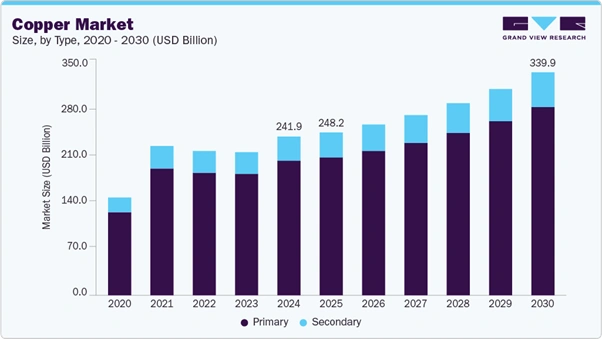
Figure 2: Global copper market size forecast from 2020 to 2030, highlighting steady growth in primary and secondary copper demand. [Source: Grand View Research]
How Capital Markets Fund Copper Projects?
Copper mining finance operates across four distinct layers covering equity, debt, streaming, and royalty financing, with each layer attracting a different type of investor at a different stage of project development
- Equity markets are the first port of call. Junior explorers list on exchanges like the ASX, TSX, and AIM to raise early-stage capital, while senior producers access equity markets for major expansion projects
- Project finance and debt step in at feasibility stage. Lenders require proven reserves, bankable feasibility studies, and offtake agreements before committing large facilities to any project
- Streaming agreements provide upfront capital to miners in exchange for the right to purchase future copper production at a fixed price, avoiding equity dilution while giving investors direct commodity exposure
- Royalty financing offers miners a lump sum in exchange for a percentage of future revenue, a lower-risk structure that suits investors with longer time horizons
Mining capital markets have seen growing participation from government-backed facilities. Australia’s Critical Minerals Facility, managed by Export Finance Australia, is one example of public capital being used to de-risk private investment.
Green bond frameworks are increasingly directing institutional capital towards copper projects that meet ESG and sustainability criteria, broadening the investor base significantly
For retail investors, understanding where a company sits in the project lifecycle, covering explorer, developer, or producer, is the single most important factor in assessing copper mining finance risk
The Funding Gap Facing Copper Supply
The role of capital markets in critical minerals is partly a story of necessity. The world needs significantly more copper than current mines can deliver. The IEA estimates that to meet net-zero targets by 2050, copper demand could more than double from today’s levels. Yet the pipeline of new projects remains thin.

Figure 3: Refined copper metal bars, representing copper’s role as a traded industrial and financial commodity. [Source: Freepik]
Copper mining finance has become harder to secure in recent years. Environmental, social, and governance requirements have lengthened approval timelines.
Capital costs have risen sharply post-pandemic. The result is a widening gap between projected demand and committed supply, a gap that only well-funded projects can begin to close.
What Investors Need to Understand?
For retail investors approaching copper mining finance for the first time, the key is understanding where in the project lifecycle a company sits. Early-stage explorers offer leverage to discovery but carry binary risk. Developers approaching construction offer a different risk profile, capital-intensive but with a clearer path to production. Producers offer leverage to the copper price with the benefit of operating cash flow.

Figure 4: Raw copper ore material, illustrating the upstream resource base supporting global copper supply chains. [Source: Freepik]
Mining capital markets reward patience and punish poor timing. Copper projects are long-dated assets. The investor who understands the funding structure, how much equity has been raised, what debt is in place, and whether streaming deals have been struck, understands the real risk far better than one who only watches the copper price.
Industry Outlook
The global copper market is entering a sustained growth phase. Building and construction led end-use demand with a 26.4% revenue share in 2024, followed by industrial equipment and transport. Primary copper accounted for 84.8% of the total market supply.
As renewable energy installations accelerate and EV adoption deepens, copper intensity per unit of energy capacity will only increase. The role of capital markets in critical minerals will grow in parallel, making copper one of the most closely watched commodities in global finance through 2030 and beyond.
FAQs
Q1. What is the role of capital markets in critical minerals like copper?
Ans. Capital markets provide the equity, debt, and alternative financing that fund copper projects from exploration through to production.
Q2. Why is copper considered a critical mineral?
Ans. Copper is essential to electric vehicles, renewable energy systems, power grids, and infrastructure. Its conductivity and corrosion resistance make it irreplaceable across the clean energy transition.
Q3. What is copper mining finance and how does it work?
Ans. Copper mining finance refers to the range of funding mechanisms used to develop copper projects, including equity raises, project finance loans, corporate bonds, and streaming or royalty agreements.
Q4. How large is the global copper market?
Ans. The global copper market was valued at US$241.88 billion in 2024 and is projected to reach US$339.95 billion by 2030, growing at a CAGR of 6.5%.