

Australia’s exchange-traded fund (ETF) market recorded its strongest year on record in 2025, with net inflows reaching approximately $53 billion. Betashares confirmed the figure in its annual review, reporting a 76% increase compared with 2024. The surge lifted total ETF assets under management (AUM) to about $330–$331 billion by the end of the year.
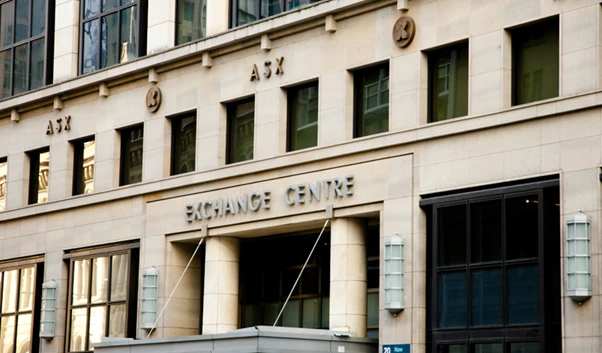
Australian ETF market records $53 billion in inflows during 2025 as assets climb above $330 billion. [Ledger Insights]
The milestone reflects sustained demand for low-cost, exchange-traded investment products. Industry participants note that the market has nearly doubled in size since 2023. As more Australians adopt ETF-based portfolios, issuers continue to expand product offerings and market share.
Record ETF Inflows Drive Assets Beyond $330 Billion
Betashares reported that Australian-listed ETFs attracted $53 billion in net inflows in 2025. The increase far exceeded the previous year’s result. Strong investor demand combined with positive equity market returns to push total assets close to $331 billion.
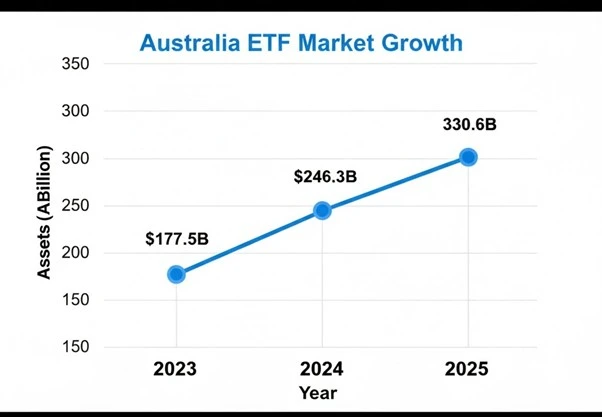
Australian ETF assets under management rise sharply between 2023 and 2025.
The growth builds on a long-term expansion trend. The Australian Securities and Investments Commission (ASIC) has previously reported that ETF assets surpassed $200 billion in 2024. That figure represented a 20-fold increase over the past decade. Market participants view 2025 as another turning point in the sector’s development.
Betashares has projected further growth. The firm expects total funds under management to exceed $400 billion during 2026 if current inflow levels continue.
Vanguard, BetaShares, and iShares Lead ETF Market Share
A small group of providers dominated ETF inflows in 2025. Vanguard, BetaShares, and BlackRock’s iShares collectively captured more than 70% of net inflows. Combined, they attracted about $37.5 billion of the $53 billion total.

Vanguard, Betashares and iShares capture over 70% of Australian ETF inflows in 2025.
Vanguard alone secured roughly $16 billion in net inflows, accounting for 31% of the annual total. By December 2025, Vanguard managed approximately $89.6 billion in Australian ETF assets. The firm retained its position as the country’s largest ETF provider.
These figures highlight continued investor preference for established managers. Large issuers benefit from scale, lower fees, and broad index-based product ranges.
Top ASX ETFs: VAS and VGS Attract Billions
Broad-based equity ETFs led individual fund inflows. The Vanguard Australian Shares Index ETF (ASX: VAS) attracted an estimated $3.0 billion in 2025. Its assets rose above $22.5 billion by year-end.
The Vanguard MSCI International Shares ETF (ASX: VGS) followed closely. It drew about $2.6 billion in net inflows. Its total assets exceeded $14 billion at the close of the year.
These funds track large domestic and global equity indices. Investors often use them as core portfolio holdings. Betashares also reported strong flows into its low-cost global and Australian equity products. The data indicates sustained demand for diversified index exposure through ETFs listed on the ASX.
New Australian ETF Listings Expand Product Choice
ETF issuers accelerated product launches throughout 2025. Between 70 and 73 new ETFs were listed on the ASX and Cboe Australia during the year. After accounting for around 15 closures, the net increase exceeded 50 products.
By the end of 2025, investors could trade approximately 453 ETFs and exchange-traded products (ETPs) across 65 issuers. This expansion widened access to various asset classes and strategies.
Cboe Australia identified 2025 as a key year for active management. About 47 new active ETFs launched during the period. Eleven new fund managers entered the exchange-traded market. The new products covered thematic strategies, fixed income, sector-focused equities, and global exposures.
Equity ETFs Lead Flows While Bonds and Gold Gain
Equity ETFs attracted the largest share of investor funds. International equity ETFs received around $20.9 billion in net inflows. The figure increased from $15.1 billion in 2024. Australian equity ETFs also recorded strong demand, drawing roughly $13.2 billion.
Market performance supported these flows. Australian shares gained about 14% in 2025, while global equities advanced roughly 19%. Investors sought broad market exposure through low-cost index funds.
Fixed-income ETFs also set new records. Australian bond and cash ETFs attracted approximately $11.6 billion in net inflows. That amount nearly doubled the 2024 level. Investors responded to interest rate volatility and income opportunities.
Gold-backed ETFs gathered about $1.8 billion, marking their strongest annual inflow on record. Rising gold prices and inflation concerns drove demand for commodity exposure.
Passive ETFs Dominate While Active Funds Rebound
Passive ETFs maintained a dominant share of investor flows. Betashares reported that index-tracking ETFs captured around $38.9 billion in 2025. Smart-beta strategies attracted approximately $8.2 billion. Actively managed ETFs drew about $6.3 billion.
The data shows investors allocated roughly six times more capital to passive funds than to active strategies. Low fees and transparency continue to drive this preference.
However, active ETFs showed signs of recovery. Cboe Australia reported $6.8 billion in net inflows into active products during 2025. The segment had experienced outflows in 2024. By year-end, active ETFs held around $68.8 billion in assets. That total represented a $15 billion increase, or 28% growth, from the previous year.
Cboe also reported that 33% of total ETF flows moved into domestic fixed income, 27% into international equities, and 22% into Australian equities. Active ETF fees averaged about 0.79%, higher than most passive products.
ASIC Issues Regulatory Guide 282 for ETF Oversight
ASIC responded to rapid industry expansion with updated regulatory guidance. In November 2025, the regulator released Regulatory Guide 282 (RG 282) for exchange-traded products.
The guide consolidates earlier materials and outlines issuer obligations, licensing requirements, and disclosure standards. It replaces the previous Information Sheet 230 and earlier guidance documents. RG 282 addresses naming conventions, liquidity arrangements, and market-maker responsibilities.

ASIC releases Regulatory Guide 282 to strengthen oversight of exchange-traded products. [Commercial Real Estate]
ASIC stated that updated guidance supports market integrity and consumer protection as ETF assets grow. The regulator cited the 20-fold increase in ETF assets over the past decade as evidence of structural change in the investment landscape.
Also Read: SEEK (ASX: SEK) H1 FY26 Revenue Up 12%,
Outlook: Australian ETF Industry Targets $400 Billion in 2026
Industry forecasts point to continued expansion. Betashares expects Australian ETF assets to exceed $400 billion in 2026 if monthly inflows remain above $5 billion. At the current pace, some projections place total assets near $500 billion by 2027 or 2028.
Market conditions will influence future results. Interest rate movements and global equity performance may affect investor behavior. Product innovation may also shape demand, particularly in active and fixed-income strategies.
The 2025 figures confirm that ETFs now form a core component of Australian investment portfolios. Record inflows, expanding product choice, and updated regulatory oversight position the market for further growth in the coming years.
FAQs
- What is driving growth in the Australian ETF market in 2025?
Ans. Strong investor inflows, low management fees and broader product choice are driving growth. In 2025, Australian-listed ETFs attracted about $53 billion in net inflows. Positive equity market returns and increased use of ETFs in diversified portfolios also supported expansion.
- How large is the Australian ETF market?
Ans. By the end of 2025, total ETF assets under management reached approximately $330–$331 billion. Industry forecasts suggest the market could exceed $400 billion during 2026 if inflow momentum continues.
- Which ETF providers dominate the Australian market?
Ans. Vanguard, Betashares and BlackRock’s iShares account for the majority of ETF inflows. In 2025, these three providers captured more than 70% of total net inflows into Australian-listed ETFs.
- What are the most popular ETFs on the ASX?
Ans. Broad index funds remain the most widely held. The Vanguard Australian Shares Index ETF (VAS) and the Vanguard MSCI International Shares ETF (VGS) ranked among the top funds by inflows in 2025, attracting billions in new investments.
- Are active ETFs growing in Australia?
Ans. Yes. While passive ETFs still attract most inflows, active ETFs gained momentum in 2025. Active exchange-traded funds recorded renewed net inflows and increased their total assets compared with 2024.
- What asset classes are attracting the most ETF inflows?
Ans. International equities led ETF inflows in 2025, followed by Australian equities and fixed income. Bond ETFs recorded near-record inflows, while gold ETFs also saw increased investor demand during the year.
- How does ASIC regulate ETFs in Australia?
Ans. The Australian Securities and Investments Commission (ASIC) oversees exchange-traded products under the Corporations Act. In November 2025, ASIC released Regulatory Guide 282 to clarify issuer obligations, disclosure standards and market-making requirements for ETFs and other exchange-traded products.