Something unusual is happening on Wall Street. Money is moving away from some of the biggest names in tech. And it is not because these companies are failing. It is because investors are asking a new question: what happens when AI starts doing the work these companies charge for?
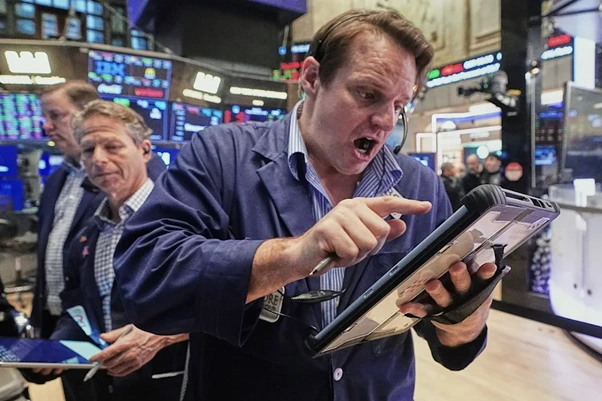
Figure 1: Traders react to market volatility on the New York Stock Exchange amid the AI scare trade [Yahoo Finance]
The AI scare trade is the name given to this shift. It describes a growing pattern where investors sell shares of companies seen as vulnerable to AI disruption. What started in software has now spread across sectors. Financial services, legal, logistics, real estate and wealth management have all felt the pressure.
AI Stock Market Impact Begins With Software and Spreads Fast
The AI stock market impact first landed hardest on software. Since peaking in October, the S&P 500 Software and Services index has shed close to US$2 trillion in market capitalisation. Investors began pricing in a world where fast-advancing AI tools replace traditional subscription and enterprise software models.
The concern is straightforward. If AI can replicate what costly software platforms do, the pricing power of those platforms erodes. “There’s this idea that AI is somehow going to replace built-out models in the near term,” said Robert Pavlik, senior portfolio manager at Dakota Wealth. That fear has been enough to trigger sharp and broad selling across the sector.
AI Scare Trade Ripples Across These Sectors
The AI scare trade did not stop at software. Here is where the pressure has spread:
- Wealth management was hit after AI-enabled tax planning features were introduced, raising fears about automation replacing traditional brokerage services
- Shares of LPL Financial, Raymond James Financial and Charles Schwab each fell more than 7% in a single session
- Data analytics and legal services followed, with Thomson Reuters shares touching a near five-year low on concerns about AI affecting its legal business
- Major index and data firms such as S&P Global, Moody’s and FactSet were not spared from the sell-off.
- Cybersecurity firms were the latest to feel pressure, with CrowdStrike dropping 5%, Zscaler falling 4% and Cloudflare down 6% after Anthropic announced a new security tool

Figure 2: Conceptual illustration representing artificial intelligence and digital transformation [Freepik]
A single concern links each of these moves. Businesses built on information, analysis and advisory work are being reassessed in a world where AI can perform those tasks at scale.
Investing in AI Stocks Means Knowing Who Builds It and Who Fears It
Investing in AI stocks today means understanding a clear divide. On one side are companies building AI infrastructure. On the other hand, there are companies whose core business could be automated away. That distinction is now driving capital allocation decisions across Wall Street.
“Everyone’s kind of going through each one, sector by sector, industry by industry, trying to figure out where the AI disruption is going to be beyond just within tech itself,” said Keith Lerner, Chief Investment Officer and Chief Market Strategist at Truist. For investors, picking AI winners is no longer enough. Identifying disruption risk across every sector is now equally important.
Where Money Is Actually Going Amid the AI Stock Market Impact
As money exits tech, it is finding new homes. Here is where capital has been rotating:
- Energy stocks are up 22% year to date, with Chevron and ExxonMobil gaining 20% and 22% respectively, driven by rising oil prices and AI infrastructure power demand
- Materials stocks are up 15% year to date as AI infrastructure buildouts accelerate demand for raw inputs
- Industrial stocks have gained 14% year to date, supported by reshoring activity and the construction of AI data centres
- Consumer Staples has attracted defensive capital, with Walmart hitting an all-time high earlier this month
“Money’s coming out of this big behemoth. Money’s moving out of tech,” Lerner said.
Investing in AI Stocks and the Broader Market Outlook
The broader picture may not be as alarming as the sector-level volatility suggests. Profit growth and the easing of interest rates by the US Federal Reserve are expected to support a wider market recovery. Polymarket participants are currently pricing in two to three rate cuts in 2026.

Figure 3: AI-driven data processing and algorithmic trading reflected through stock market charts [Freepik]
UBS strategists see the conditions for healthy and broadening profit growth across sectors. The firm predicts the S&P 500 could reach 7,700 by year end. “We see attractive opportunities across financials, health care, utilities, consumer discretionary, and industrials,” UBS strategists noted. For investors, the AI scare trade may ultimately be less about fear and more about a long-overdue repricing of where value actually sits.
Industry Outlook
The AI stock market impact is accelerating a structural shift in how capital is allocated across global markets. As AI capabilities expand, every sector with a labour or information-intensive business model faces reassessment. Analysts estimate approximately one-fifth of the private credit market carries exposure to the software sector, underlining how interconnected these disruption risks have become. The rotation currently underway may mark the beginning of a multi-year rebalancing rather than a short-term correction.
Frequently Asked Questions
Q1. What is the AI scare trade?
Ans. It refers to a market pattern where investors sell shares of companies considered vulnerable to AI disruption, spreading from software to financial services, legal and cybersecurity sectors.
Q2. Which sectors have gained from the AI stock market impact?
Ans. Energy, Materials and Industrials have been the primary beneficiaries, with energy stocks up 22% year to date as of 20 Feb 2026.
Q3. Is investing in AI stocks still worthwhile?
Ans. Investing in AI stocks remains relevant, but the focus has shifted toward companies building AI infrastructure rather than those at risk of being disrupted by it.
Q4. Where is the S&P 500 headed?
Ans. UBS strategists predict the S&P 500 could reach 7,700 by year end, supported by expected Federal Reserve rate cuts and broadening profit growth.