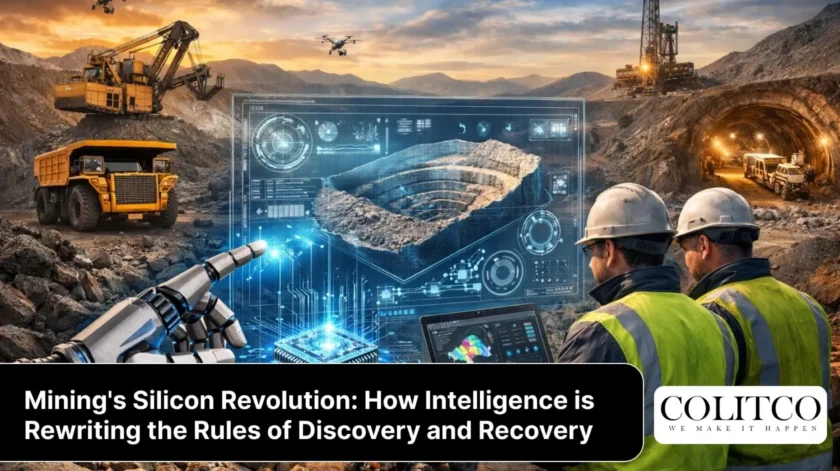
The mining sector has entered uncharted territory.
What was once an industry built on geological intuition and brute-force extraction is now being reshaped by algorithms that can spot mineral deposits invisible to the human eye and sort through waste with precision previously thought impossible.
The numbers tell a remarkable story. Traditional mineral exploration delivers success rates around 0.5 per cent. Modern AI-powered targeting has flipped those odds to 75 per cent. Companies that once spent years chasing dead ends are now pinpointing deposits in months.
Meanwhile, operations across Australia, North America, and beyond are discovering that yesterday’s waste rock contains tomorrow’s revenue stream. Sensor-based sorting systems are pulling millions of dollars’ worth of minerals from material that would have sat in tailings dams indefinitely.
This isn’t a distant future scenario. The transformation is happening now, across operations from Queensland’s tungsten mines to copper projects in Zambia.
The Discovery Problem That Demanded a New Solution
The easy deposits are gone. Discovery rates for new mineral deposits have plummeted 75 per cent over the past decade.
The traditional approach relies on drilling campaigns with painfully low success rates. Greenfield projects face odds of 1 in 5,000 for commercial success. That’s expensive, time-consuming, and increasingly unsustainable given global demand for critical minerals.
Enter machine learning algorithms that process geological data at scales impossible for human teams. These systems analyse historical drilling logs, geochemical surveys, satellite imagery, geophysical readings, and seismic data simultaneously.
The result is pattern recognition that reveals mineralisation signatures human geologists would miss. A recent survey found 77 per cent of exploration professionals now use some form of AI tooling in their operations.
From Satellite to Subsurface: How AI Identifies Hidden Deposits
Modern mineral targeting combines predictive algorithms with remote sensing technology that covers vast terrain quickly.
Multispectral and hyperspectral imaging capture hundreds of narrow spectral bands from satellite and aerial platforms. Machine learning systems then classify these images automatically, identifying surface anomalies and alteration patterns that signal mineralisation below.
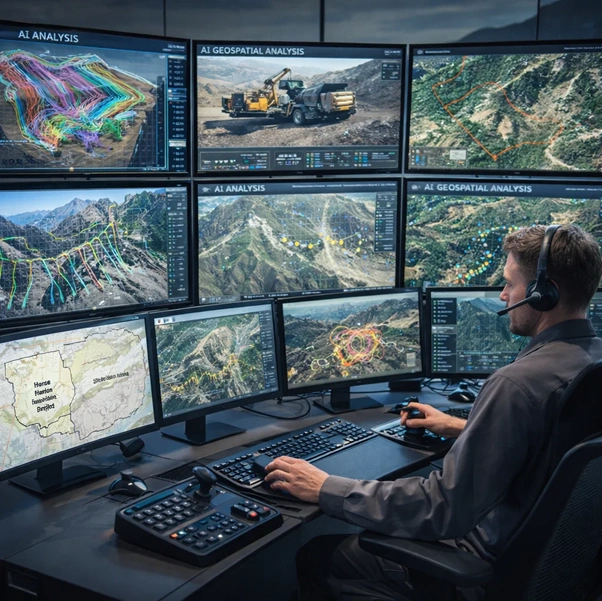
AI systems analyse multiple data streams simultaneously to identify high-probability mineral targets.
This proves particularly valuable in regions like the Canadian Shield, the Amazon basin, and Australia’s outback, where traditional field surveys are impractical, dangerous, or prohibitively expensive.
Australian explorers are deploying predictive prospectivity models alongside digital twins and private 5G infrastructure for autonomous trials. Major producers collaborate with cloud and AI vendors to create data pipelines that fuse satellite imagery, geophysics, and historical drilling into ranked drill targets.
The efficiency gains are substantial. Industry estimates suggest AI-driven exploration could deliver annual savings of USD 290 billion to USD 390 billion by 2035, slashing discovery costs by as much as 80 per cent.
Real Results: KoBold Metals and the Mingomba Discovery
The technology has moved well beyond pilot programs. KoBold Metals used AI-powered targeting to discover the Mingomba copper deposit in Zambia, one of the most significant finds in recent years.
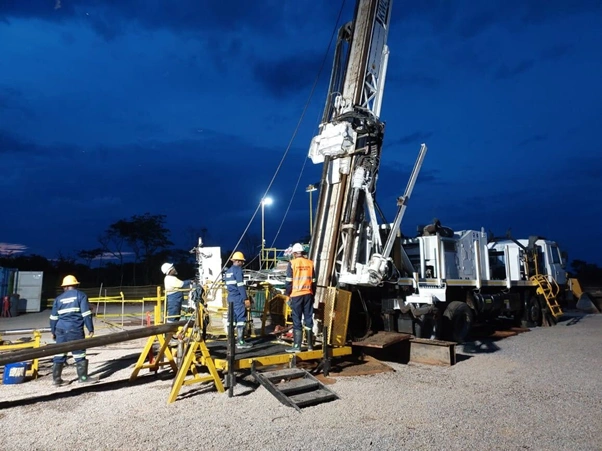
Mingomba Mine Project Site [Presidential Delivery Unit, Zambia]
Their approach analysed massive historical datasets to identify geological patterns associated with copper mineralisation. The system ranked thousands of potential sites and directed drilling to the highest-probability targets.
That’s not an isolated case. Companies like Earth AI and VerAI are applying similar methodologies across multiple commodities and jurisdictions. VerAI takes a unique approach by staking mineral rights on AI-identified targets and partnering for development, creating an asset-light model that appeals to investors seeking exposure without operational risk.
In Queensland, mining companies are integrating AI prospectivity mapping with ground-truthing to accelerate resource definition while reducing environmental footprint.
Automated Ore Sorting: Turning Waste Into Infrastructure
While AI reshapes exploration, sensor-based sorting is redefining what counts as waste.
Mining operations generate vast volumes of waste rock that get hauled long distances, stockpiled, and monitored for decades. At the same time, these same operations import aggregate for haul roads, plant foundations, and tailings dams.
The paradox is obvious. Much of that waste rock has the strength and durability for construction use. The barrier has been sulphides and acid-forming material mixed throughout.
X-Ray Transmission (XRT) sorting solves that problem. The technology creates detailed images of each rock as it moves along conveyor belts, detecting fine-grained inclusions like base metal sulphides with exceptional accuracy.
High-value, acid-forming particles get ejected from the feed stream. What remains is barren, low-sulphide material that can be managed with confidence, placed in long-term storage, used on-site, or sold as commercial aggregate.
TOMRA Technology Delivers USD 20 Million in Recovered Gold
TOMRA Mining’s advanced sorting systems are demonstrating the commercial viability of waste recovery across multiple operations.
At Kensington Mine in Alaska, XRT sorting recovers high-density particles containing sulphide minerals and associated gold into the concentrate stream while rejecting low-density waste. The environmental bonus is a barren waste fraction with minimal acid-generating potential.
The financial outcome is striking. The operation recovered 4,216 ounces of gold from pebble sorting in one year. In January 2026, gold prices represent almost USD 20 million in recovered value while still producing a clean, low-sulphide waste stream.
Queensland’s Mt Carbine operation shows similar results processing tungsten-bearing ore. TOMRA XRT sorters generate a barren waste stream that gets repurposed as commercial aggregate. Material that would have been ground down to 6mm and sent through jigs is now retained in coarser fractions suitable for sale.
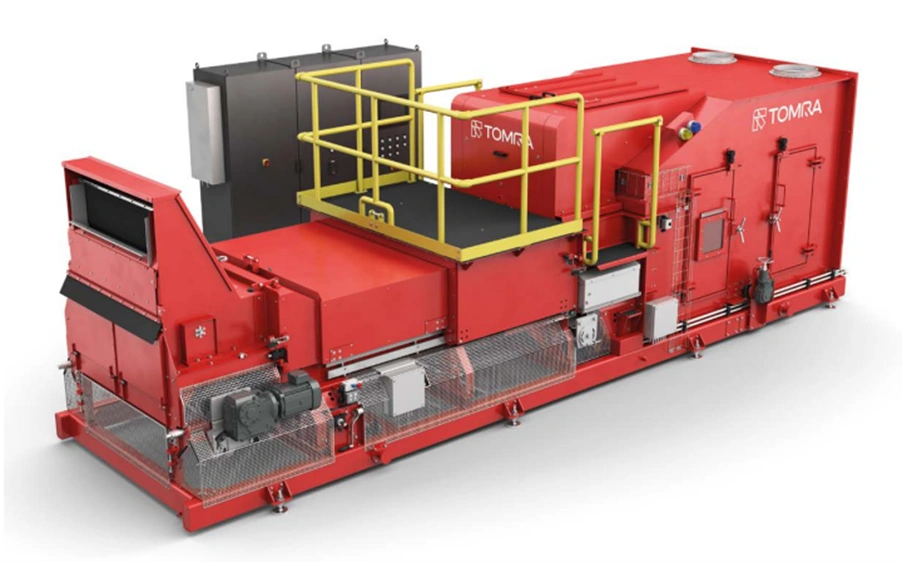
X-Ray Transmission sorting technology separates valuable minerals from waste rock with exceptional precision. [Tomra]
The Bluestone Mining Tasmania Joint Venture uses XRT sorting to separate non-acid-forming waste, placing large portions of waste rock directly in long-term storage while reducing environmental risk and underground placement needs.
Deep Learning Pushes Sorting Accuracy to New Heights
TOMRA’s latest innovation, CONTAIN, applies convolutional neural networks to real-time X-ray imagery analysis. The system identifies visual patterns that traditional sorting misses, giving operators precise control over grade-recovery thresholds.
Each rock receives a probability score based on its likelihood of containing subsurface ore mineral inclusions. This enables data-driven sorting decisions adapted in real time whether the goal is maximising concentrate grade, minimising valuable material loss, or aligning with processing cost constraints.
The system handles a wide spectrum of ore grades. Conventional sorters can detect some low-grade material but tend to let large volumes of gangue enter the product stream, diluting output. CONTAIN uses deep learning to classify mineralisation with exceptional accuracy, making low-grade ore recovery economically viable.
To date, the system has been trained on tens of thousands of ore samples and proves particularly effective for tungsten, nickel, and tin classification. The technology maintains pinpoint accuracy even in dense, fast-paced input streams critical for high-volume processing plants.
Market Expansion Reflects Surging Adoption
The sensor-based sorting machines for the mining market reached USD 145 million in 2025 and is forecast to hit USD 286.6 million by 2035, registering a compound annual growth rate of 7.1 per cent.
Mid-capacity sorter units (150 to 350 tons per hour) held approximately 45 per cent of market share in 2025. These systems offer the best cost-impact ratio economically, removing 20 to 40 per cent of feed waste on average while proving ideal for brownfield retrofits and greenfield modular plants with phased expansions.
Practical applications span pre-concentration of base metal ores, separation of critical minerals to improve battery-grade concentrate quality, and reprocessing of tailings and low-grade stockpiles to recover previously uneconomical materials.
The broader AI in mining market tells a similar growth story. Valued at USD 35.47 billion in 2025, forecasts predict expansion to USD 828.33 billion by 2034 at a compound annual growth rate of 41.92 per cent.
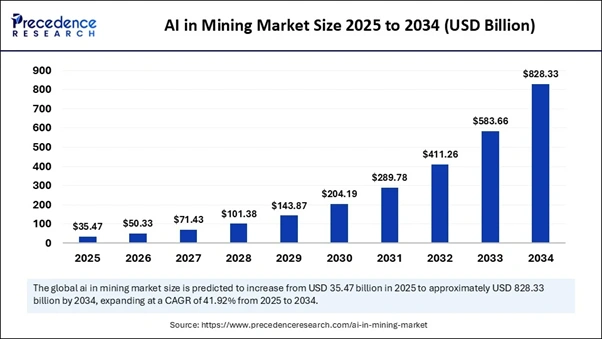
Chart showing AI in Mining Market Growth 2025-2034 [Precedence Research]
Asia Pacific leads adoption with USD 14.19 billion in 2025, projected to reach USD 335.47 billion by 2034. Surface mining accounts for 55 per cent of market share, though underground mining shows the fastest growth as operators deploy AI for safety tools and predictive maintenance to minimise risk in hazardous environments.
Implementation Challenges Remain Despite Strong Momentum
Adoption faces several persistent barriers. Budget constraints weigh heavily on smaller companies. Larger organisations cite skills gaps, capacity limitations, and integration complexity as greater concerns. Mid-sized companies appear best positioned to adopt and operationalise AI tools, given sufficient resources without bureaucratic constraints.
A 2025 survey found that while 77 per cent of exploration professionals report some AI tool usage, 22 per cent indicated no observable outcomes yet. Results vary significantly across organisations based on implementation maturity and data quality.
Geologists demonstrate the highest scepticism towards AI and machine learning tools, followed by field managers and executives. Functional specialists show the highest usage levels. This pattern highlights the need for better change management and stakeholder engagement as new technologies roll out.
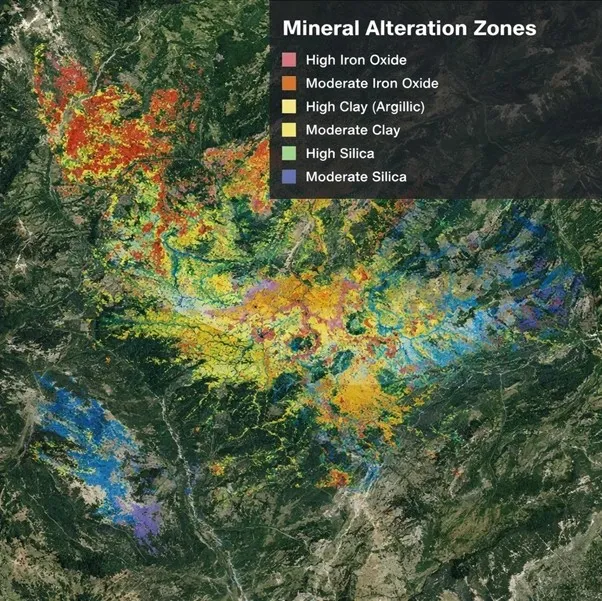
Hyperspectral satellite imagery reveals surface anomalies and mineralisation signatures across vast terrain.
Data governance presents another hurdle. Fragmented legacy datasets limit model performance. Establishing interoperability standards for geodata requires cross-sector coordination that’s still developing.
Cybersecurity risks associated with connected field assets add another layer of complexity. Operations must balance the benefits of real-time data transmission against potential vulnerabilities in remote locations.
The Road Ahead: Autonomous Systems and Sovereign AI
Looking forward, mining faces mounting pressure to secure critical minerals for clean energy, electronics, and defence applications. Supply chain resilience has become a geopolitical priority.
The United States, European Union, Australia, and other jurisdictions are implementing policies to reshore mineral processing and reduce dependency on concentrated foreign sources. AI and automation play central roles in making domestic production economically viable.
Autonomous haulage, drilling, and processing are expanding beyond pilot programs into standard operations. BHP operates autonomous drills across five iron ore mine sites in Western Australia, controlled remotely from Perth hundreds of kilometres away. Last year, the company converted all 33 trucks and 5 drilling rigs at its Spence copper mine in Chile to full automation.
The integration of AI with blockchain, digital twins, and Internet of Things sensors creates fully connected mining ecosystems where every decision is supported by real-time data. Processing plants adjust crushing, grinding, and separation dynamically based on incoming ore composition, optimising reagent use, energy consumption, and throughput simultaneously.
Environmental monitoring has become AI-powered as well. Satellite and drone platforms track water usage, emissions, waste output, and ecological health continuously. Predictive analytics help companies maintain compliance, track carbon footprints, and adopt low-impact processes.
Post-mining rehabilitation increasingly relies on AI-guided models that analyse satellite monitoring data on soil quality, vegetation regrowth, and topographic change to inform restoration strategies.
Investor Implications and Strategic Positioning
For investors, these developments create opportunities across multiple segments. Infrastructure providers like Nvidia and Broadcom supply the computational backbone. Software companies like Palantir apply AI to decision-making across operations. Specialised technology firms like TOMRA and NextOre deliver equipment and systems directly to mine sites.
Junior explorers using AI prospectivity modelling can punch above their weight, testing solutions and scaling successes that gradually change industry perceptions of what size and resources are required for meaningful discoveries. The ability to transform raw geological data into strategic insight is becoming as valuable as traditional scale advantages.
Major producers benefit from operational efficiency gains, extended mine life through waste recovery, and improved sustainability metrics that support ESG goals and access to capital. Bloomberg estimates ESG assets could exceed USD 40 trillion by 2030, giving well-prepared companies preferential access to lower-cost funding.
The mining sector’s evolution from manual and equipment-heavy methods to AI-driven operations represents a fundamental shift in how mineral resources are discovered, extracted, and processed. Companies that integrate both human expertise and artificial intelligence into every stage of operations will define the industry’s next chapter.
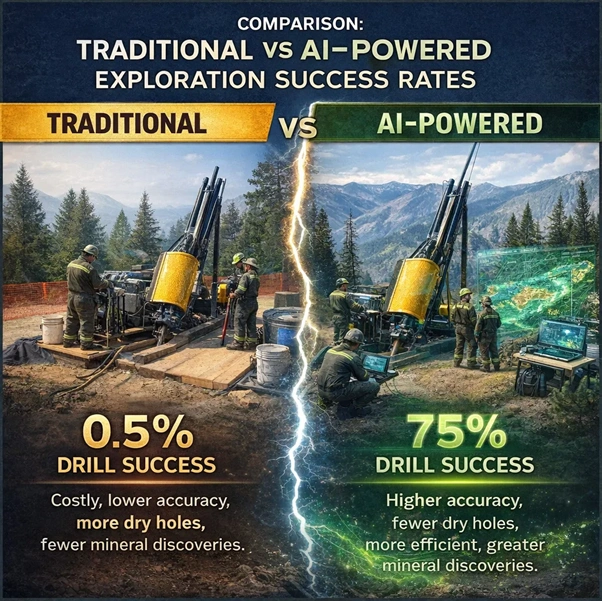
Traditional vs AI-Powered Exploration Success Rates
Progress won’t be measured solely by extraction volume but by efficiency, responsibility, and the insights applied throughout the value chain. As global demand for critical minerals continues rising, those who master the silicon revolution will secure competitive advantages that persist for decades.
FAQs
Q: How does AI improve mineral exploration success rates?
A: AI analyses massive geological datasets, including historical drilling, satellite imagery, geophysics, and geochemistry, to identify mineralisation patterns invisible to human geologists. Modern AI-powered targeting achieves drill success rates around 75 per cent compared to traditional rates of 0.5 per cent, reducing discovery times from years to months.
Q: What is automated ore sortin,g and how does it work?
A: Automated ore sorting uses X-ray transmission technology and machine learning to analyse rocks on conveyor belts, detecting valuable minerals and acid-forming materials. High-value particles are separated for processing while barren waste is diverted for safe placement, reuse as aggregate, or sale, transforming waste management economics.
Q: Which companies are leading AI adoption in mining?
A: Technology providers TOMRA Mining, NextOre, and sensor manufacturers lead equipment supply. Major miners like Rio Tinto, BHP, and Vale implement AI across operations. Exploration companies KoBold Metals, Earth AI, and VerAI apply AI specifically for discovery. Software firms Palantir and various cloud providers deliver analytics platforms.
Q: What challenges prevent faster AI adoption in mining?
A: Budget constraints affect smaller companies while larger organisations face skills gaps, integration complexity, and legacy data issues. Geologists show higher scepticism than other roles. Cybersecurity risks, regulatory compliance, data governance requirements, and change management challenges slow implementation despite proven benefits.
Q: How much can mines save through AI implementation?
A: Industry estimates suggest AI-driven exploration could deliver USD 290 billion to USD 390 billion in annual savings by 2035, cutting discovery costs up to 80 per cent. Individual operations report waste reductions of 15 to 25 per cent, water consumption decreases of 20 to 30 per cent, and millions in recovered minerals from former waste streams.